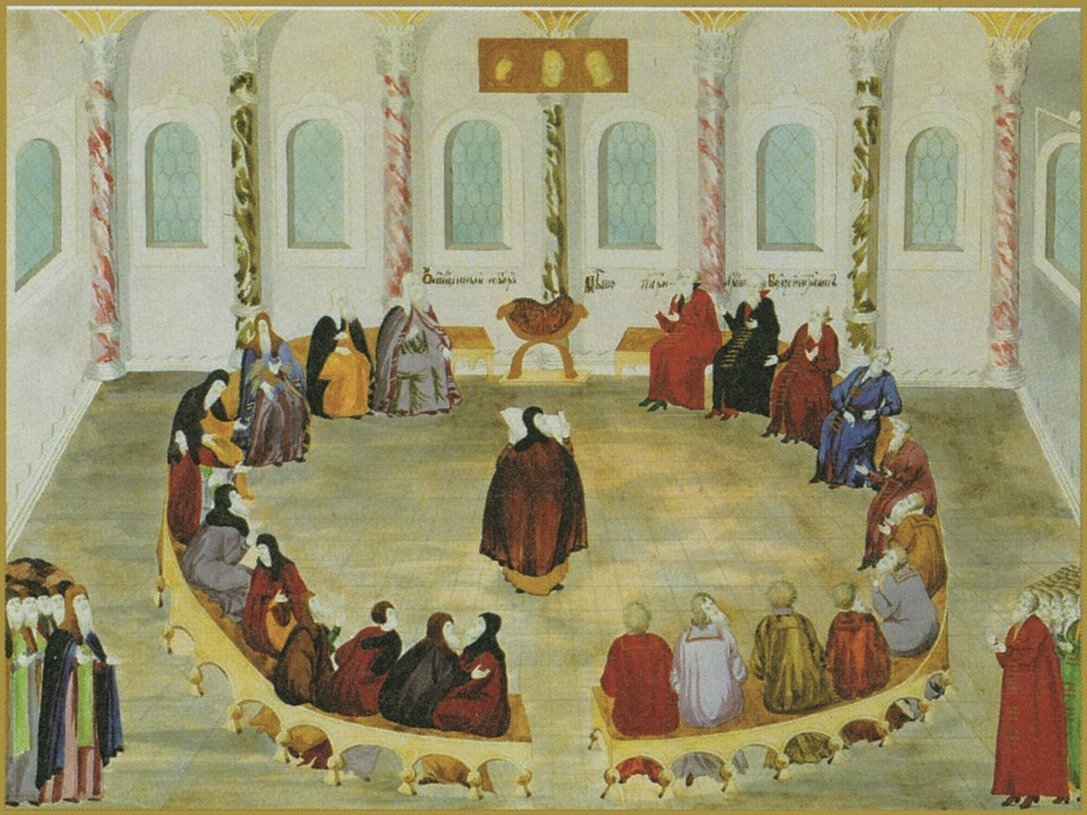
An Assembly Elects Mikhail Romanov Tsar
After years of famine, pretenders and foreign occupation known as the Time of Troubles, a national assembly chose sixteen-year-old Mikhail Romanov, founding a dynasty.
In January 1613 (Old Style), delegates from across Russia gathered in the ruined capital of Moscow to resolve a catastrophic leadership vacuum. Following the end of the Rurikid ruling line and years of civil war, famine, and foreign intervention known as the Time of Troubles, an armed uprising led by Kuzma Minin and Prince Dmitry Pozharsky had successfully expelled Polish forces from the Kremlin in late 1612. To legitimize a permanent government, the interim leadership summoned a national assembly, or Zemsky Sobor. Because the city had suffered extensive destruction, the assembly met in the Kremlin's Assumption Cathedral, with estimates of attendance varying widely, up to about 1,500 delegates representing the estates of the realm.
The council faced the urgent task of choosing a monarch who could unite fractured factions and establish lasting authority. Assemblies of this kind dated back to the council of 1549 under Ivan IV, but previous councils had served only as advisory bodies under reigning sovereigns. In 1613, however, the assembly wielded sovereign power to elect a ruler. Early in the proceedings, delegates excluded foreign royalty, rejecting claims from Prince Vladislav of Poland and Prince Carl Philip of Sweden, along with the family of the late impostor False Dmitry II. The electors resolved instead to seek an indigenous sovereign from among the established Russian families.

Keep reading in Yester
Coming soonKeep following the story
Sources
Image: Unknown author · Public domain · Wikimedia Commons · cropped
