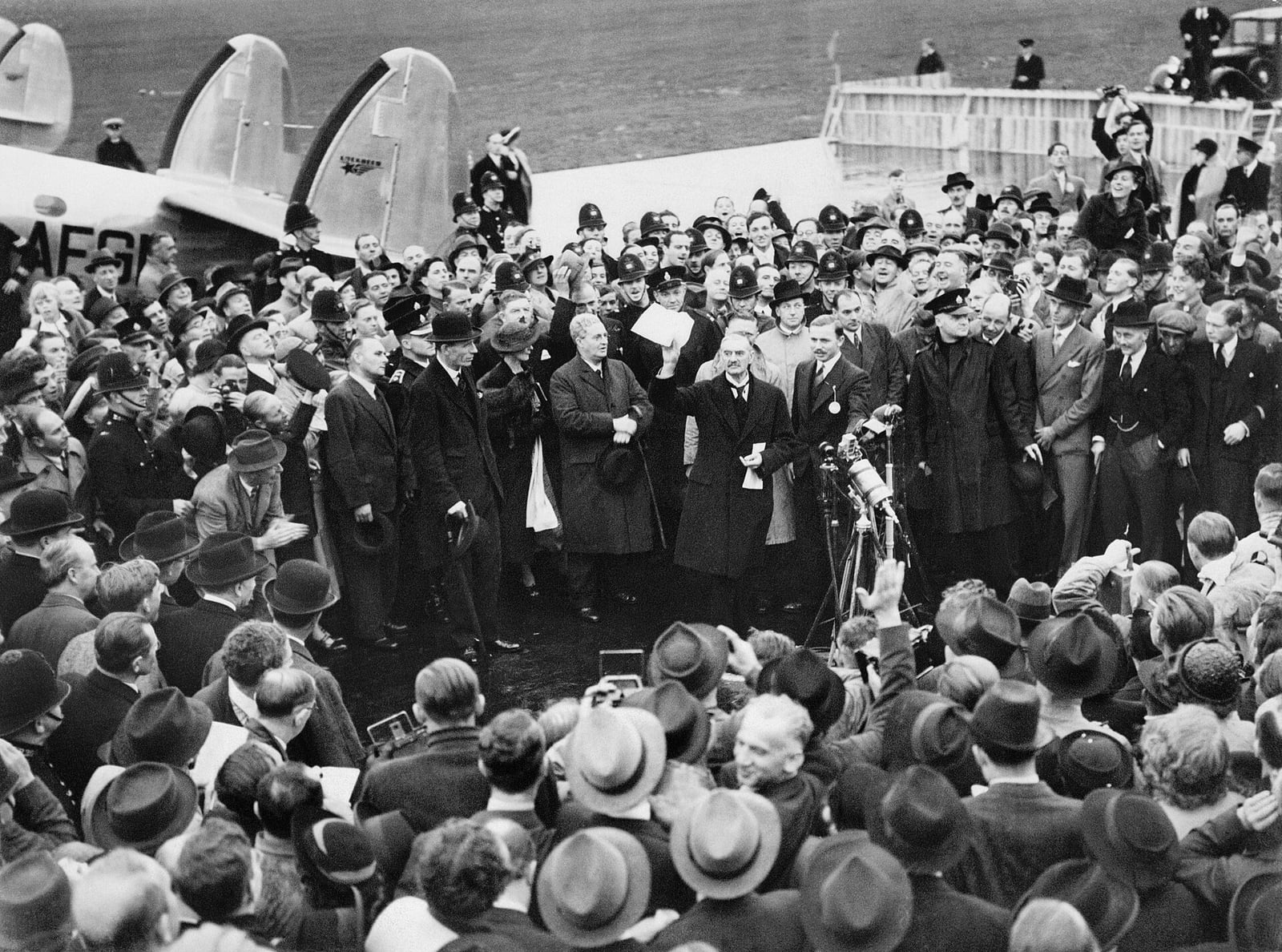
Britain and France Accept Hitler’s Terms at Munich
To avoid war, two democracies let Germany annex Czechoslovakia’s border regions without asking the Czechoslovaks.
In the early hours of September 30, 1938, representatives of Germany, the United Kingdom, France, and Italy signed the Munich Agreement. The pact ceded the Czechoslovak border regions known as the Sudetenland to Nazi Germany. About three million ethnic Germans lived in the mountainous territory, which had historically formed a natural frontier and housed Czechoslovakia's extensive system of defensive fortifications. Despite their country being partitioned, Czechoslovak delegates were kept out of the principal negotiations, waiting in the Bavarian city while the major European powers decided their nation's borders.
The diplomatic crisis had escalated rapidly across 1938. When the First Czechoslovak Republic was established in 1918 following the collapse of Austria-Hungary, the Sudeten Germans were included within its borders without formal consultation. The Great Depression hit the export-dependent industries of the German-speaking border regions far harder than the Czech interior, deepening tensions between the two communities. Konrad Henlein, leader of the separatist Sudeten German Party, received explicit instructions from Adolf Hitler in March 1938 to make demands that the government in Prague could never accept.

Keep reading in Yester
Coming soonKeep following the story
Sources
- Munich Agreement (Military History Institute Prague, VHU)
- Czech Republic: Munich (Library of Congress Country Studies)
- Hitler's Sportpalast speech, 26 September 1938, Document 2358-PS (Avalon Project, Yale Law School)
- The last year of peace (Institute of National Remembrance, Poland)
- Munich Agreement timeline (World History Encyclopedia)
- Remembering the Munich Agreement (Radio Prague International)
- Munich Agreement
Image: Ministry of Information official photographer · Public domain · Wikimedia Commons · cropped
