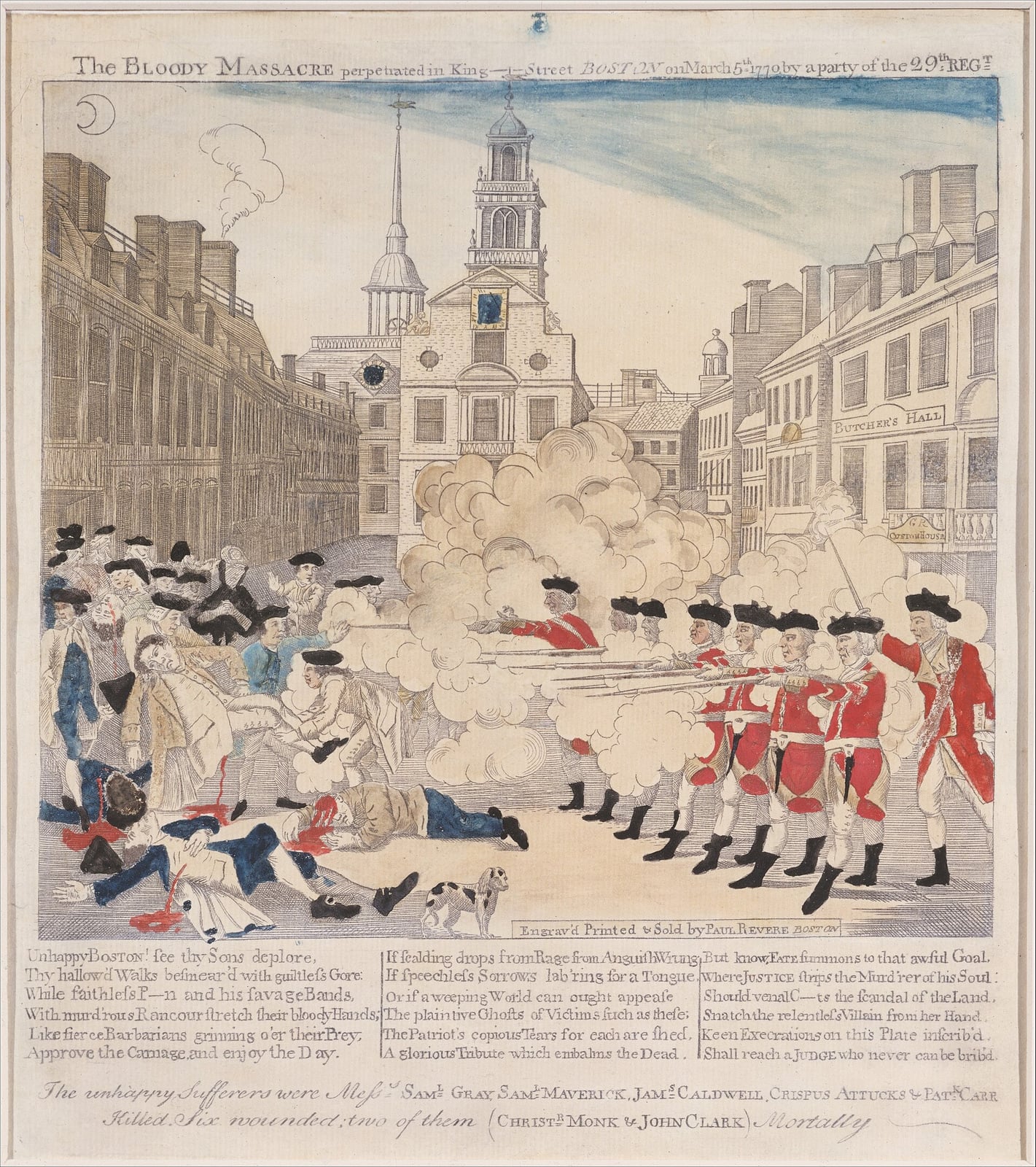
British Soldiers Fire on a Crowd in Boston
Soldiers facing a hostile crowd on King Street killed five colonists, and Paul Revere’s engraving turned the shooting into a symbol of British tyranny.
On October 1, 1768, British Army regiments began landing in Boston to back crown officials and enforce parliamentary revenue measures. Colonial resistance to taxation had escalated over the preceding years, prompting British authorities to dispatch military forces after riots broke out over customs seizures. By 1770, two regiments of foot remained stationed in the port city. Mutual resentment between Bostonians and British soldiers produced frequent skirmishes, amplified by press accounts and inflamed by the February 1770 killing of eleven-year-old Christopher Seider by a customs employee.
The friction culminated on the evening of March 5, 1770, outside the Boston Custom House on King Street. Private Hugh White struck an apprentice wigmaker during an argument over an unpaid officer's account, drawing an angry group of onlookers. As church bells rang, a hostile crowd that grew to perhaps several hundred people gathered around White, hurling snowballs, stones, and insults. Captain Thomas Preston led a relief party of seven soldiers from the 29th Regiment to the sentry's aid, and the armed detachment soon formed a defensive semicircle on the Custom House steps.

Keep reading in Yester
Coming soonKeep following the story
Sources
Image: Paul Revere · Public domain · Wikimedia Commons · cropped
