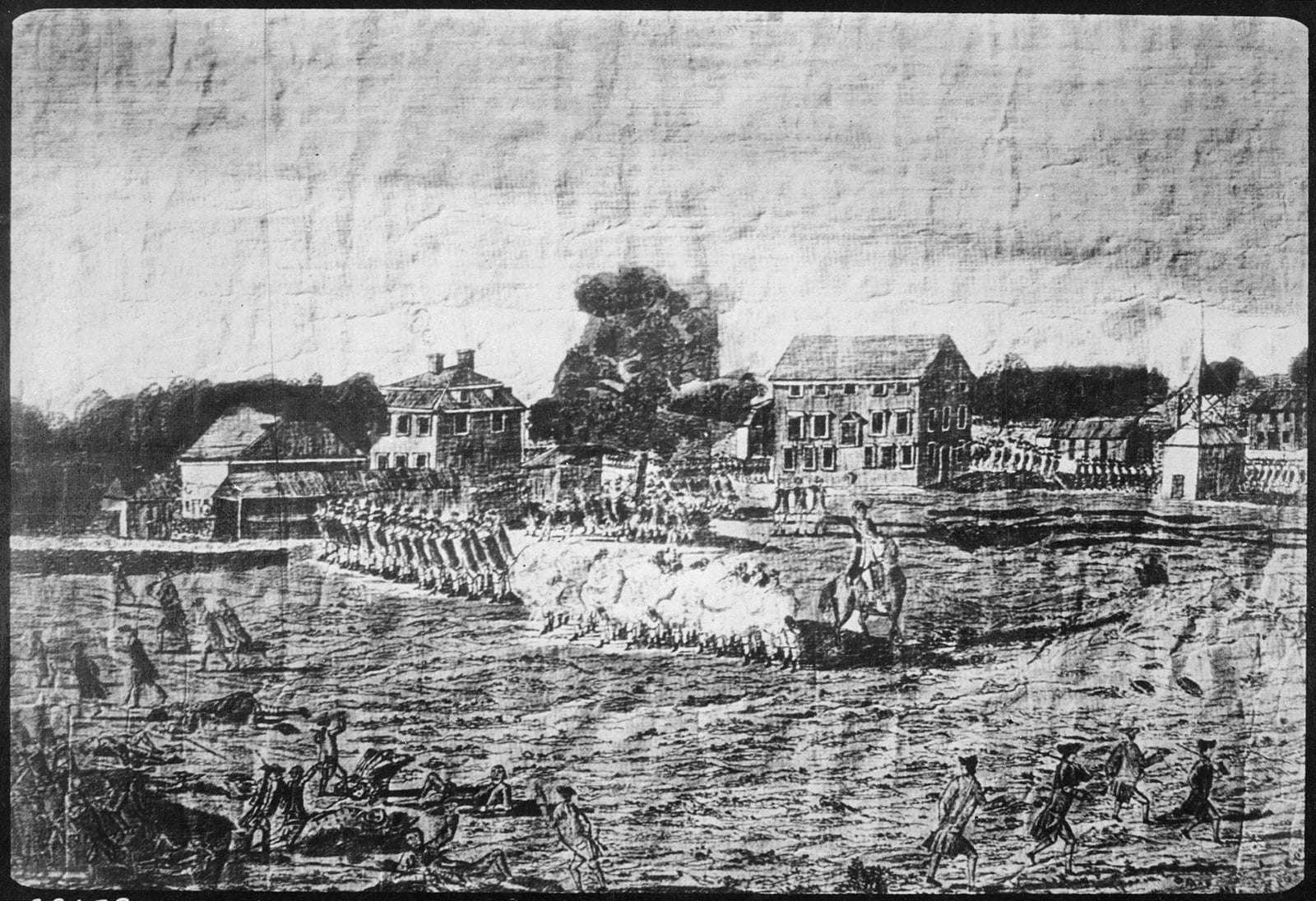
Shots at Lexington and Concord Start the American Revolutionary War
British troops marching to seize colonial military stores met militia at Lexington and Concord and were harried all the way back to Boston.
During the late evening of April 18, 1775, approximately 700 British Regulars gathered at the western edge of Boston Common. Acting under confidential instructions from General Thomas Gage, the military governor of the Province of Massachusetts Bay, Lieutenant Colonel Francis Smith prepared to lead an ad hoc force across the water into Cambridge. Gage intended for the detachment to march inland to Concord, where provincial forces were accumulating arms, gunpowder, and stores. Anticipating such a move, colonial leaders had already hidden or moved much of their provisions to neighboring towns. Riders including Paul Revere and William Dawes slipped out of Boston that evening to awaken the countryside and alert the militias.
The British soldiers landed in waist-deep water around midnight and commenced their march in damp uniforms along muddy roads. By early morning, colonial alert systems consisting of express riders, ringing bells, and firing guns had alerted the villages of Middlesex County. As the British advance guard under Marine Major John Pitcairn reached Lexington at sunrise on April 19, around 80 local militiamen stood drawn up in formation on the town green under the command of Captain John Parker. Parker positioned his men in plain view but not obstructing the road to Concord, hoping to present a determined display without initiating bloodshed.

Keep reading in Yester
Coming soonKeep following the story
Sources
- Lexington and Concord (American Battlefield Trust)
- Battle of Lexington and Concord (Encyclopaedia Britannica)
- Battles of Lexington and Concord (History.com)
- The Shot Heard Round the World (Concord Museum)
- Coming of the American Revolution: Lexington (Massachusetts Historical Society)
- Battles of Lexington and Concord
Image: Unknown author · Public domain · Wikimedia Commons · cropped
