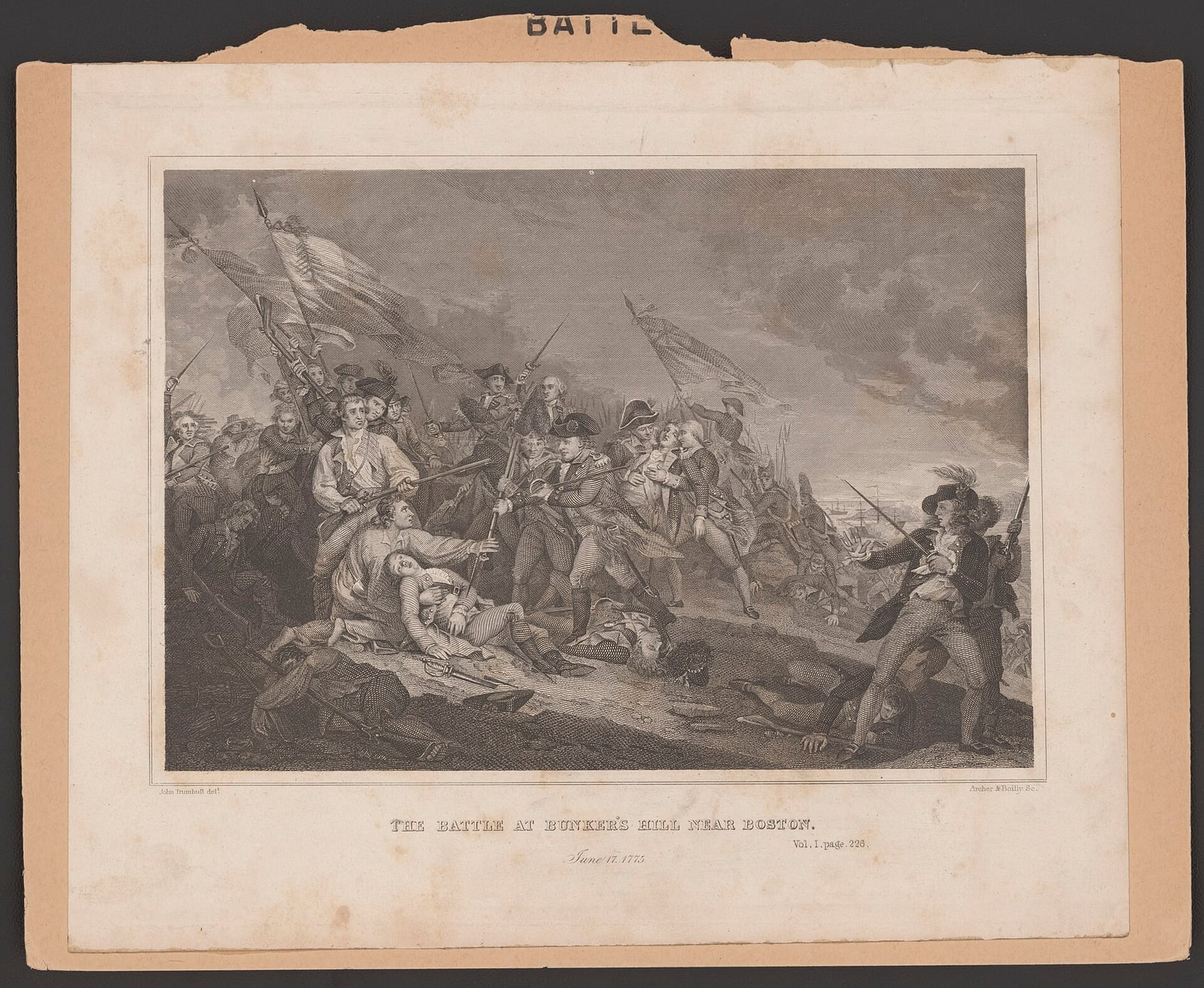
The British Take Bunker Hill at a Heavy Cost
British regulars took the heights above Boston on their third assault, losing more than a thousand men killed and wounded against colonial militia.
On the night of June 16, 1775, roughly 1,000 to 1,200 provincial soldiers marched onto the Charlestown Peninsula across from Boston. Their leaders had learned of a British plan to seize the surrounding high ground and fortify the harbor. Seeking to preempt the move, Colonel William Prescott led the detachment to construct earthen ramparts. Although colonial commanders had been instructed to occupy Bunker Hill, they chose instead to fortify Breed's Hill, an adjacent rise positioned closer to the British fleet and the city itself. Working overnight, the troops dug a roughly square earthen redoubt.
Daylight brought immediate artillery fire from British vessels anchored in the harbor, as well as from shore batteries atop Copp's Hill. Realizing that the redoubt sat exposed to a flank attack from the east, Prescott ordered an auxiliary breastwork and rail fence extended down toward the water. Around midday, British regular infantry under Major General William Howe began landing at Moulton's Point on the peninsula. Howe initially awaited reinforcements after observing colonial troops gathering in the distance, a delay that allowed New Hampshire units under John Stark to reach the field and plug a critical opening along the Mystic River.

Keep reading in Yester
Coming soonKeep following the story
Sources
Image: Archer & Boilly.; Trumbull, John, 1756-1843, artist · Public domain · Wikimedia Commons · cropped
