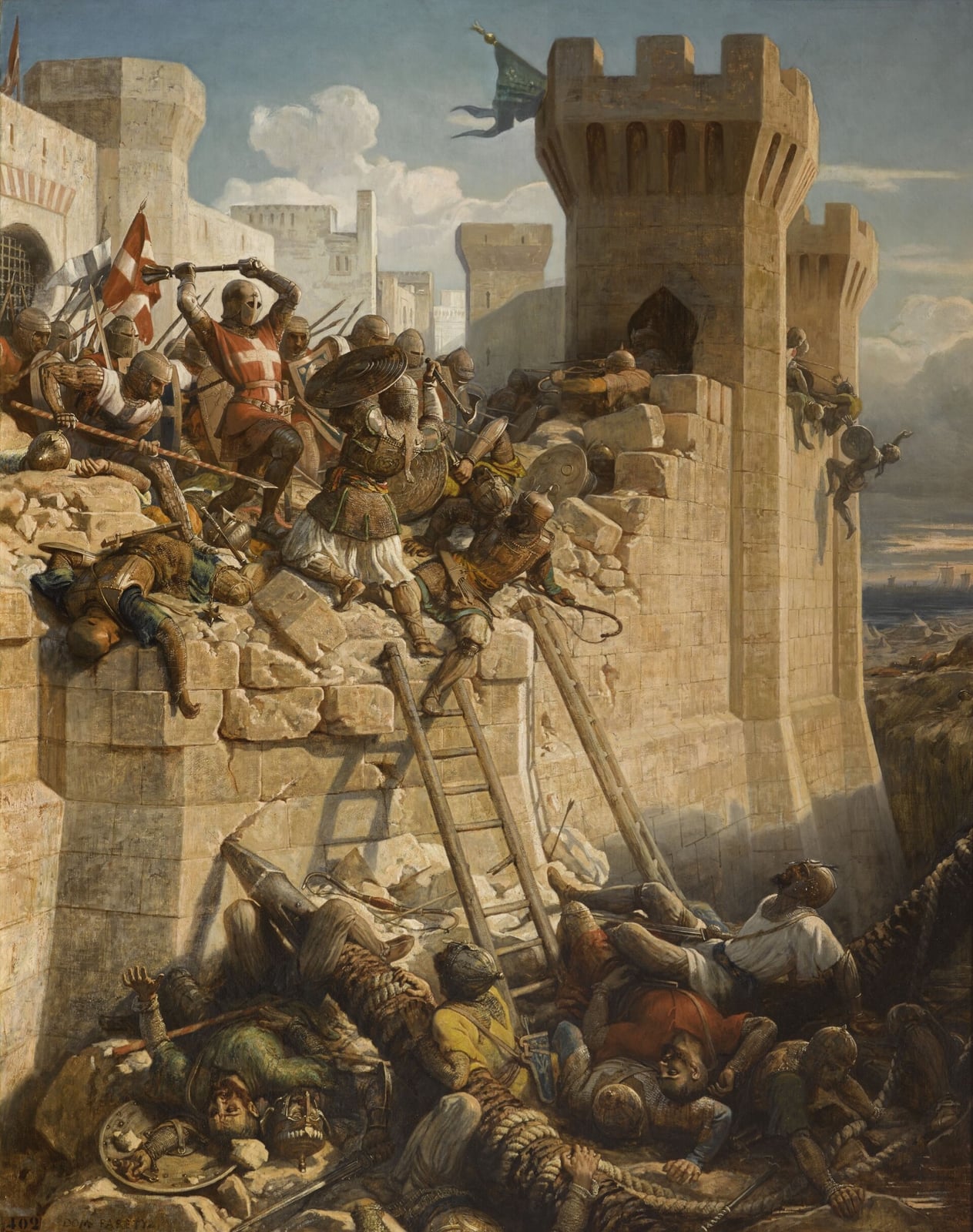
Acre Falls and the Crusader States End
A Mamluk army under Sultan al-Ashraf Khalil stormed Acre, the last great crusader city in the Holy Land, and the remaining outposts were abandoned within months.
Acre had served as the operational capital of the Kingdom of Jerusalem for a century, ever since Christian armies recovered the port in 1191 during the Third Crusade. By the late thirteenth century, however, the Crusader presence across the Levant had collapsed to a precarious fringe of coastal enclaves. The rise of the Mamluk Sultanate in Egypt fundamentally altered the regional balance of power. Mamluk armies steadily dismantled Christian strongholds throughout Palestine and Syria, capturing Antioch in 1268 and the County of Tripoli in 1289. Appeals sent by Latin authorities to European monarchs yielded little meaningful support, as Western rulers remained consumed by regional rivalries and papal crusading initiatives had repeatedly been redirected toward internal political conflicts.
The fragile peace holding Acre came apart in 1290. Ill-disciplined Italian troops who had arrived to reinforce the town attacked and killed Muslim merchants near the town in August 1290, according to the historian Steven Runciman. When Sultan Al-Mansur Qalawun demanded the handover of the culprits to answer for the killings, the municipal leadership rejected the ultimatum. Qalawun subsequently declared the existing truce void and began military preparations, though his death late in 1290 (sources give November or December) briefly paused the campaign. His son and successor, Al-Ashraf Khalil, promptly resumed the offensive, rejecting diplomatic missions sent by the Latin authorities and assembling imperial forces from Egypt and Syria.

Keep reading in Yester
Coming soonKeep following the story

Sources
Image: Louis-Dominique Papety · Public domain · Wikimedia Commons · cropped
