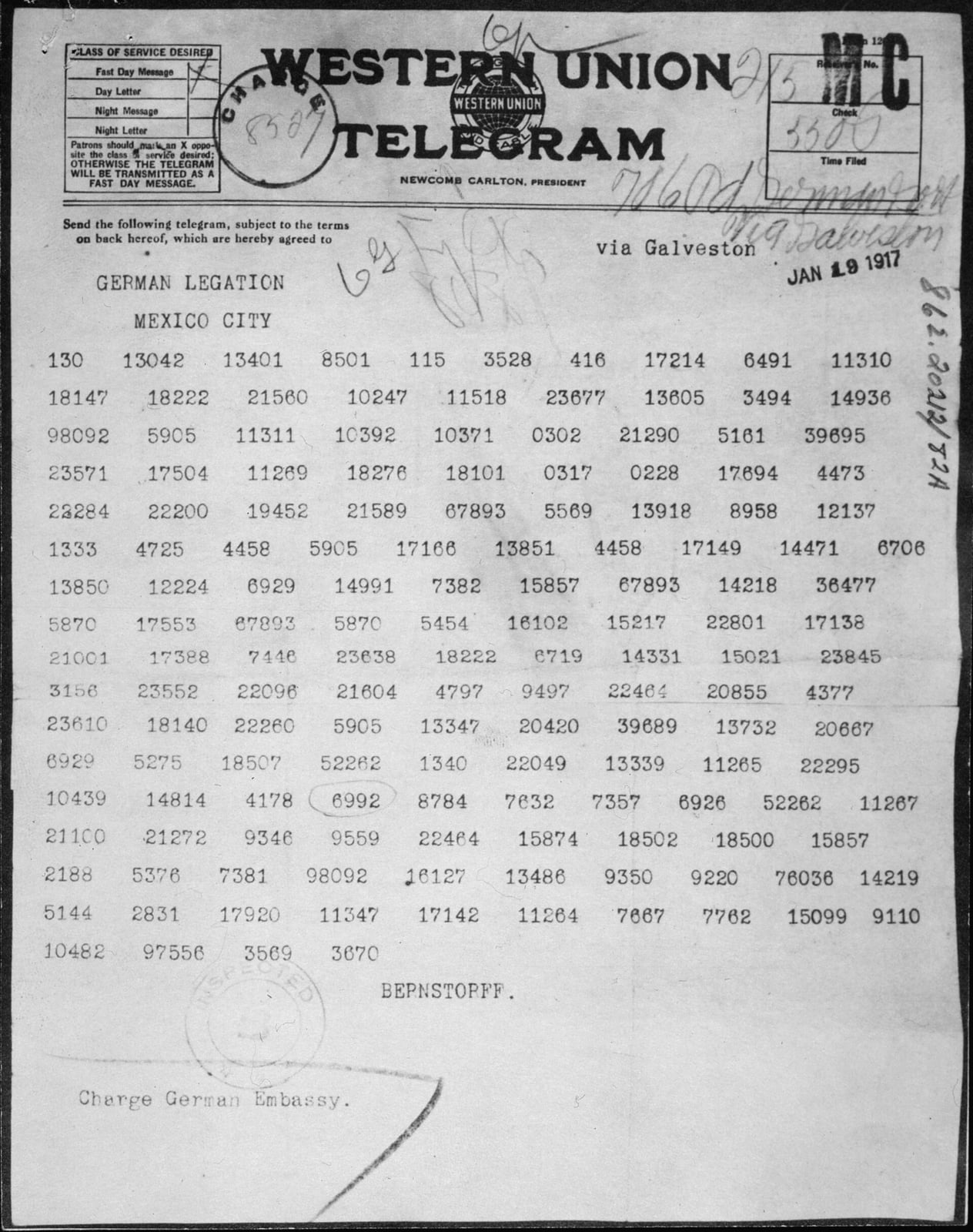
A Decoded Telegram Helps Bring the United States into the War
Germany’s secret offer of an alliance to Mexico, decoded by British intelligence, turned American opinion toward war.
On January 16, 1917, the German Foreign Office delivered a coded cable to the American embassy in Berlin for transmission across the Atlantic. Because British forces had severed Germany's transatlantic telegraph lines at the start of the war, German diplomats relied on an arrangement in which the neutral United States, under President Woodrow Wilson, agreed to relay their encrypted diplomatic messages. The message, dispatched by State Secretary for Foreign Affairs Arthur Zimmermann, was addressed to the German minister in Mexico, Heinrich von Eckardt. Instead of proposing terms for peace, the cable instructed Von Eckardt to seek a military alliance with the Mexican government if the United States entered the conflict.
The German proposal was drafted in anticipation of Germany's planned resumption of unrestricted submarine warfare on February 1, 1917. Expecting that attacks on neutral shipping would provoke the United States into war, German leaders hoped to divert American troops and military supplies away from Europe. Zimmermann instructed Von Eckardt to offer Mexico financial backing and assistance in reconquering its lost territories in Texas, New Mexico, and Arizona. Von Eckardt was also asked to suggest that Mexican President Venustiano Carranza invite Japan, which was already fighting alongside the Allies, to switch sides and join the proposed pact.

Keep reading in Yester
Coming soonKeep following the story
Sources
- The Zimmermann Telegram (National WWI Museum and Memorial)
- The Zimmermann Telegram (U.S. National Archives)
- The Zimmermann Telegram and Room 40 (UK Foreign Office history blog)
- The Secret History of the Zimmermann Telegram (History.com)
- Zimmermann Telegram Published in United States (History.com)
- Mexico's response to the Zimmermann offer (Mexico News Daily)
- Zimmermann telegram
Image: Unknown author · Public domain · Wikimedia Commons · cropped
