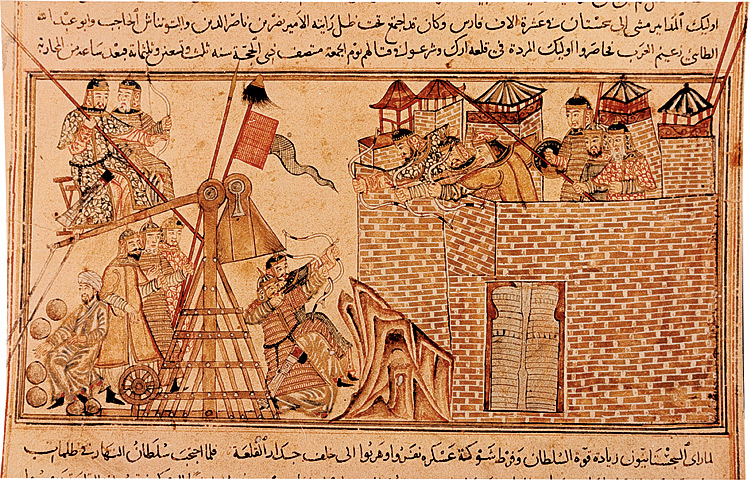
Counterweight Trebuchets Break the Song Fortress of Xiangyang
After a siege of about five years, Kublai Khan’s army used counterweight trebuchets built by engineers from the west to force Xiangyang to surrender.
In 1268, the forces of the Mongol ruler Kublai Khan encircled the fortified twin cities of Xiangyang and Fancheng, positioned across the Han River in modern Hubei province. Xiangyang stood as the primary obstacle to a southern conquest. Because the Han River flowed directly into the Yangtze River, controlling the fortress offered access to the heartland of the Southern Song dynasty. Recognising the site as vital to their survival, the Song had constructed formidable defences, including broad moats and strong walls.
Initial assaults revealed the limits of traditional Mongol siege warfare. The surrounding terrain and waterways constrained the movement of mounted cavalry, and early bombardment from traction trebuchets failed to crack the reinforced battlements. Song defenders held out behind deep walls and stockpiled provisions meant to withstand years of isolation. In response, Yuan commanders turned to encirclement, raising a ring of forts to sever overland approaches and deploying a fleet to monitor the Han River. Repeated relief operations by Song ground units were intercepted, leaving the garrison increasingly reliant on dwindling internal stores.

Keep reading in Yester
Coming soonKeep following the story
Sources
- China: Invasion of the Song state (Encyclopaedia Britannica)
- Mongol Warfare (World History Encyclopedia)
- Political History of the Song Period (chinaknowledge.de)
- Kublai Khan (World History Encyclopedia)
- The Mongol Siege of Xiangyang and Fan-ch'eng and the Song military (De Re Militari)
- Battle of Xiangyang
Image: Unknown author · Public domain · Wikimedia Commons · cropped
