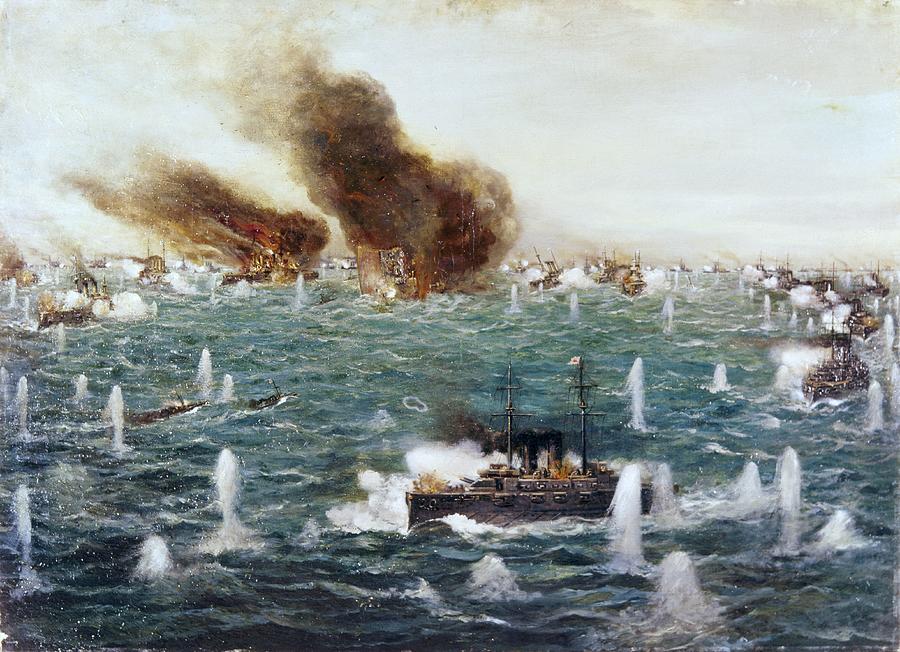
Japan’s Fleet Destroys Russia’s Navy at Tsushima
Admiral Tōgō’s fleet destroyed most of a Russian fleet that had sailed halfway around the world, a defeat that pushed Russia toward peace.
In the early hours of May 27, 1905, the armed Japanese merchant cruiser Shinano Maru identified an unfamiliar vessel navigating through dense fog in the Tsushima Strait. The lights belonged to the Russian hospital ship Orel, trailing behind the Baltic Fleet. Having sailed for about seven months to reach the Far East, the Imperial Russian Navy's Second and Third Pacific Squadrons were attempting to slip unnoticed into the port of Vladivostok. Shinano Maru promptly transmitted a wireless dispatch to Admiral Tōgō Heihachirō aboard his flagship Mikasa, alerting the Japanese Combined Fleet to sortie and intercept the advancing force.
The Russian expedition had set out from Baltic ports in the autumn of 1904 to restore naval control after Japanese forces blockaded and ultimately seized Port Arthur. The journey proved grueling. Deprived of normal docking access in neutral harbors, the armada had to carry out dozens of coaling sessions at sea, and tropical illnesses weakened the crews. Furthermore, months spent underway left hulls heavily encrusted with marine growth, severely impairing the warships' speed. By the time Admiral Zinovy Rozhestvensky led his fleet toward the narrow passage separating Korea and southern Japan, his squadrons possessed an advantage in battleship numbers but suffered from deficient training, mechanical wear, and far slower maneuvering speeds.

Keep reading in Yester
Coming soonKeep following the story
Sources
- Battle of Tsushima (Encyclopaedia Britannica)
- The Russo-Japanese War: surrender of Nebogatov's squadron (JACAR, National Archives of Japan)
- The Russian version of the Battle of Tsushima (Theodore Roosevelt Center, Dickinson State University)
- Battle of Tsushima (EBSCO Research Starters)
- Battle of Tsushima
Image: Tōjō Shōtarō · Public domain · Wikimedia Commons · cropped
