Hunters Wipe Out Steller’s Sea Cow in 27 Years
A gentle giant related to the manatee was first described in 1741 and eaten to extinction by fur traders.
In November 1741, the crew of the Russian Great Northern Expedition was shipwrecked on Bering Island in the North Pacific. Among the survivors was the German naturalist Georg Wilhelm Steller, who recorded the strange marine life inhabiting the shallow coastal waters. He documented an enormous, slow-moving sirenian grazing on coastal kelp forests, a creature soon known as Steller's sea cow. Steller's detailed observations, later published posthumously in 1751 as On the Beasts of the Sea, became the primary scientific record of a mammal that Europeans had never encountered before.
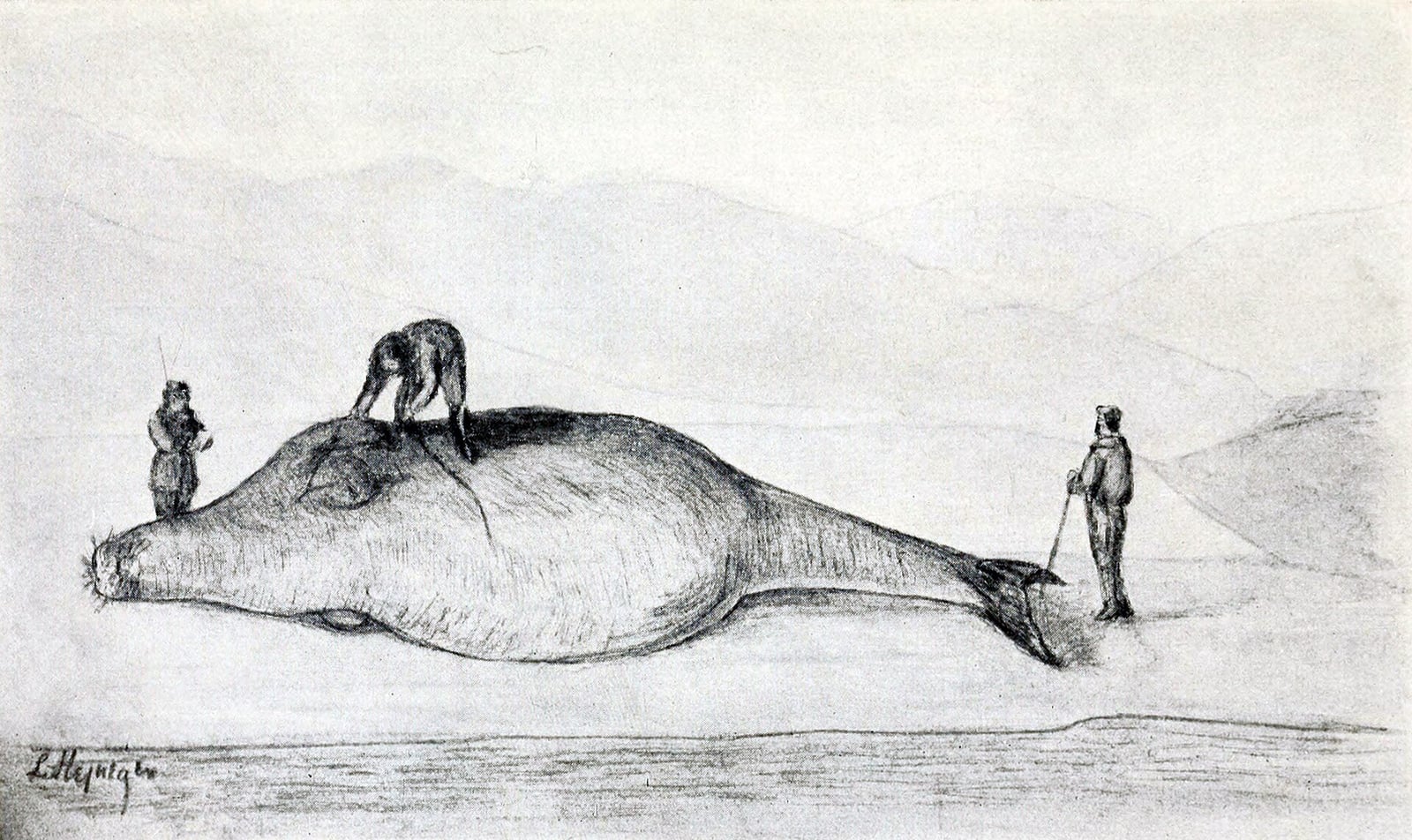
Steller's sea cow, Hydrodamalis gigas, was a colossal relative of the modern dugong. Adults grew to around nine meters long, and the largest may have weighed ten metric tons or more. Unlike living sirenians, it was probably too buoyant to submerge completely, floating along the water's edge where it fed on the canopy of shallow kelp beds. It lacked true teeth, using a dense array of white bristles on its upper lip and two keratinous masticatory pads inside its mouth to tear and chew vegetation. To survive the subarctic waters, it had a thick layer of blubber beneath a rough, bark-like hide.

Keep reading in Yester
Coming soonKeep following the story


Sources
- Steller's sea cow: the first historical extinction of a marine mammal at human hands (Natural History Museum, London)
- The 30-foot sea cow quickly hunted to extinction because of its tasty meat (National Geographic)
- Turvey and Risley, Modelling the extinction of Steller's sea cow (Biology Letters, via PubMed Central)
- Steller's Sea Cow (Science and the Sea, University of Texas Marine Science Institute)
- Steller's sea cow
Image: Leonhard Stejneger (1851 – 1943) · Public domain · Wikimedia Commons · cropped
