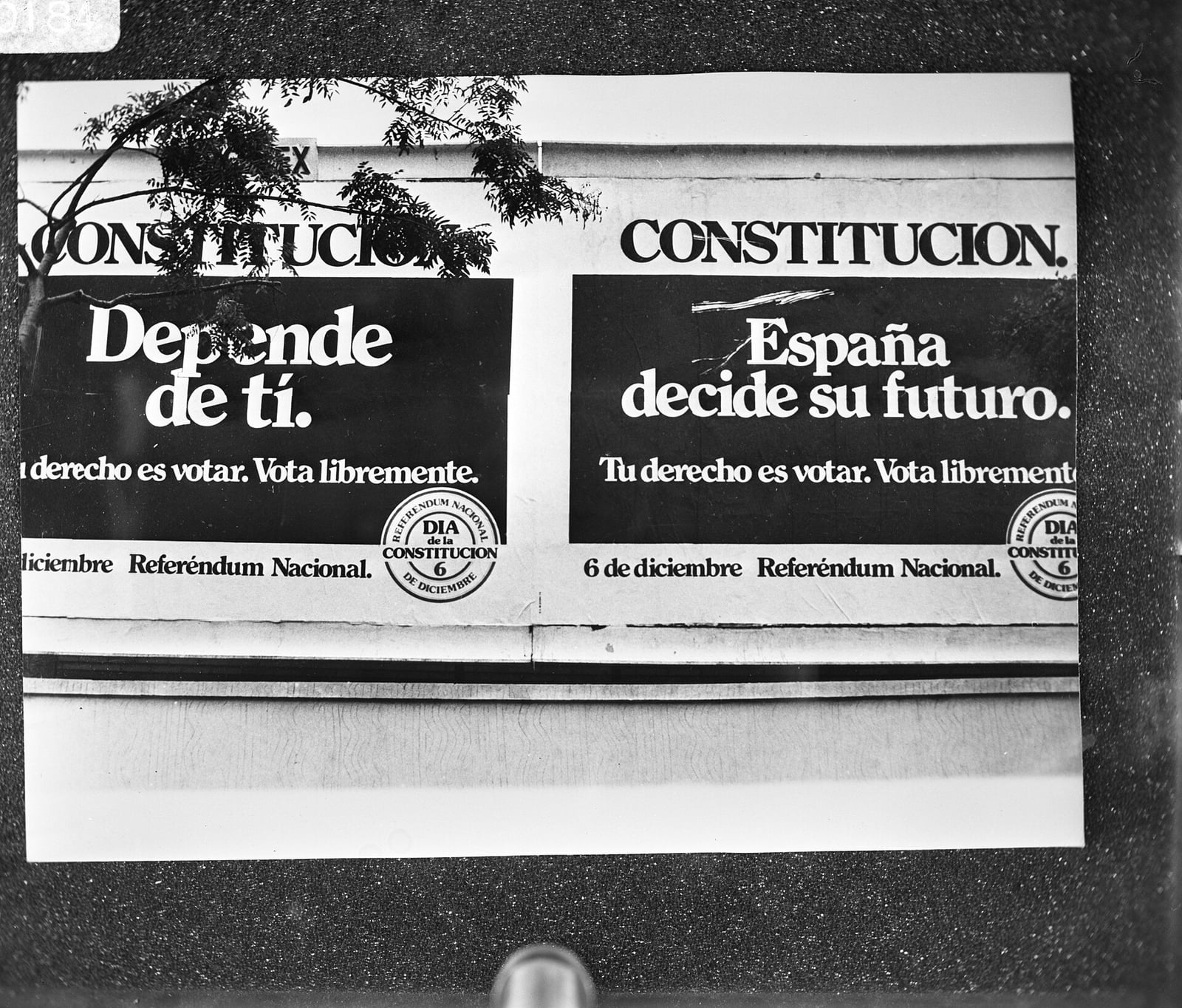
Spain Votes for a Democratic Constitution
Three years after Franco’s death, Spaniards approved a constitution that made the country a parliamentary monarchy.
On December 6, 1978, Spanish voters went to the polls in a nationwide referendum to approve a new democratic constitution. The ballot offered a direct public verdict on a compromise document crafted to move the country away from nearly forty years of authoritarian rule under General Francisco Franco, who had died in November 1975. When the votes were tallied, about 88 percent of those who voted approved the text, on a turnout of about 67 percent. That December vote represented the culmination of Spain's transition toward a parliamentary system, transforming a dictatorial apparatus into a social and democratic state governed by law.
Drafting the new charter had begun following the general election of 1977, which produced a parliament that took on the task of establishing a stable legal basis for the state. A seven-member committee drawn from across the divided parliamentary factions, informally called the fathers of the Constitution, prepared the initial text. Their draft reflected negotiations among disparate political forces, including the governing Union of the Democratic Centre, the Socialists, the Communists, Popular Alliance and the Catalan nationalists. Rather than reflecting the unilateral vision of a single faction, the finished work emerged as a negotiated settlement designed to accommodate conflicting views on society, power, and regional identity.

Keep reading in Yester
Coming soonKeep following the story
Sources
Image: Anefo · CC0 · Wikimedia Commons · cropped
