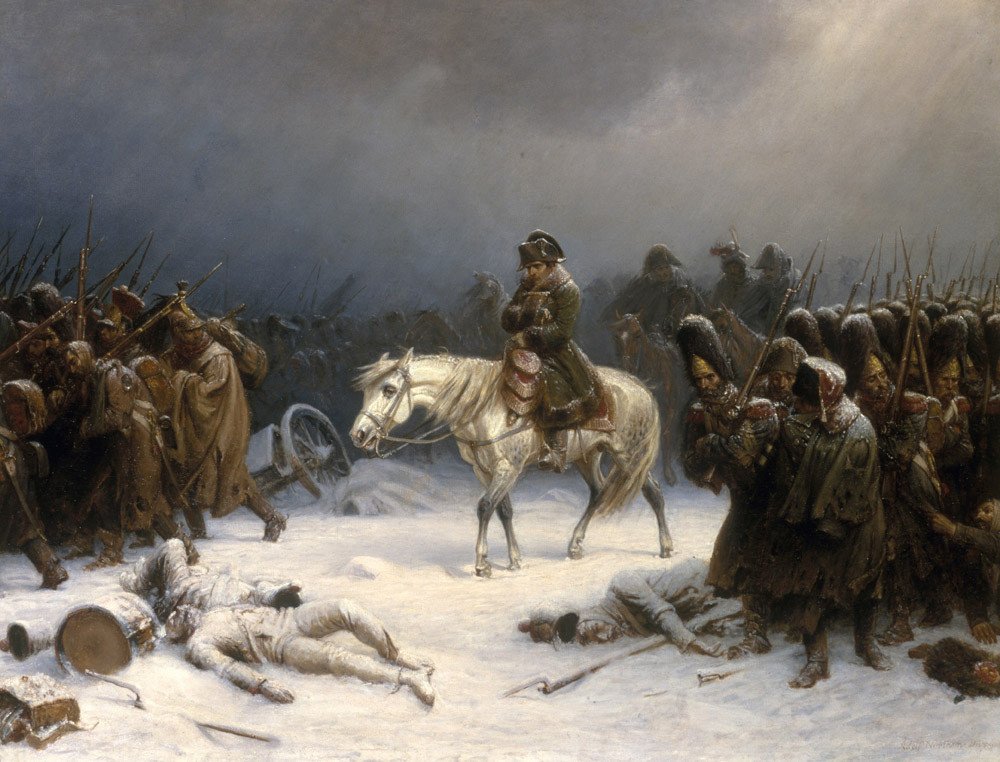
Napoleon’s Grande Armée Marches to Moscow and Back
Several hundred thousand men crossed into Russia in June 1812; after Borodino and a burning Moscow, the winter retreat left only a fraction of them alive.
On 24 June 1812, the vanguard of Napoleon Bonaparte's multinational Grande Armée commenced crossing the Neman River into the Russian Empire. Napoleon had mobilized an army that historians usually put at more than 400,000 men in the first wave and about 600,000 in all, supported by a vast baggage train and very many horses. His strategic aim was not permanent conquest, but to defeat the Imperial Russian Army in western borderlands and compel Tsar Alexander I to restore the Continental System, an economic blockade against Britain from which Russia had withdrawn late in 1810.
Advancing rapidly through present-day Lithuania and Belarus, French columns reached Vilnius, which Napoleon entered on 28 June. The planned logistical network collapsed almost immediately. Primitive dirt roads, transformed by summer downpours into mud and later baked hard by summer heat, shattered wagons and crippled horses. Deprived of regular provisions and clean water, soldiers suffered from exhaustion, dysentery, and typhus. By the time the central army advanced east toward Vitebsk and Smolensk, the army had already lost many thousands of men to disease, starvation, and desertion before any major battle took place.

Keep reading in Yester
Coming soonKeep following the story
Sources
- The retreat from Moscow (Britannica, Napoleonic Wars)
- Napoleon's Invasion of Russia timeline (World History Encyclopedia)
- The history of the destruction of Moscow 1812 (Fondation Napoleon)
- Charles Joseph Minard (Linda Hall Library)
- Minard's flow map, 1869 (historyofinformation.com)
- Battle of Maloyaroslavets (History of War)
- Kutuzov takes Command Part I (War History Online)
- French invasion of Russia
Image: Adolph Northen · Public domain · Wikimedia Commons · cropped
