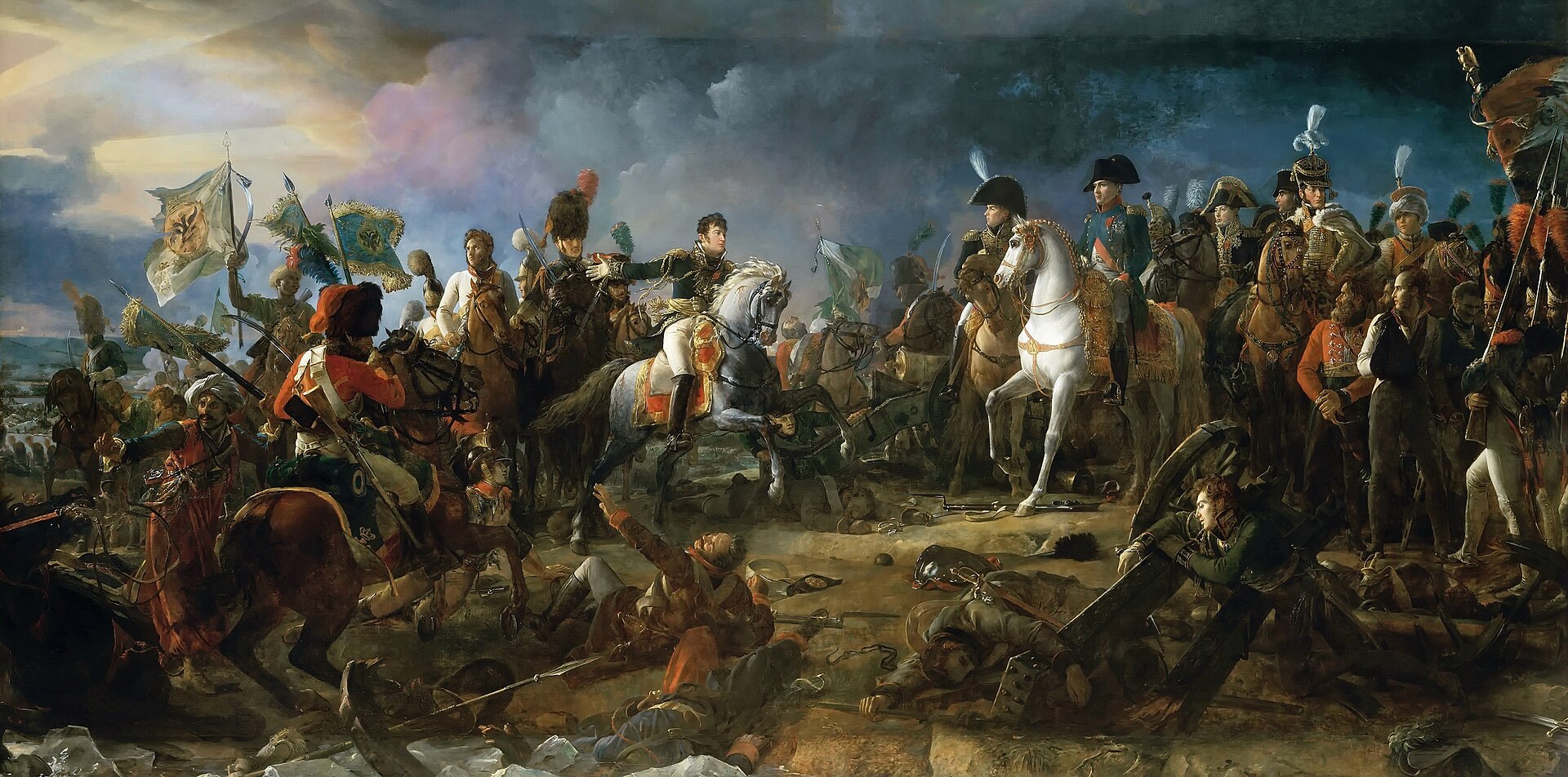
Napoleon Defeats Two Emperors at Austerlitz
On the anniversary of his coronation, Napoleon routed the Russian and Austrian armies in Moravia, his most celebrated victory.
On 2 December 1805, the French Grande Armee confronted a numerically superior allied force near the Moravian town of Austerlitz, situated in what is now the Czech Republic. The engagement proved to be the decisive clash of the War of the Third Coalition, matching Emperor Napoleon against the combined imperial armies of Russia and Austria. Although popular accounts dubbed the encounter the Battle of the Three Emperors, Emperor Francis of Austria and Tsar Alexander I were both present with the allied army, and Alexander exercised strong influence over the allied command alongside the veteran general Mikhail Kutuzov.
The tactical foundation of the battle rested on an elaborate deception planned by Napoleon in late November. Following the surrender of an Austrian army at Ulm and the subsequent French capture of Vienna, the French campaign was threatened by stretched supply lines and allied reinforcements. In response, Napoleon deliberately projected an impression of frailty. He requested a ceasefire, dispatched diplomatic envoys expressing an eagerness for peace, and ordered his troops to abandon the prominent Pratzen Heights overlooking the valley. These actions encouraged the allied leadership, led by Austrian Chief of Staff Franz von Weyrother and swayed by the Russian tsar, to reject Kutuzov's plan for a continued retreat eastward and prepare an immediate assault.

Keep reading in Yester
Coming soonKeep following the story
Sources
- The Battle of Austerlitz (Napoleonic Archive, Univ. of Wisconsin-Madison/Napoleonic Archive)
- Battle of Austerlitz (napoleonguide.com)
- Treaty of Pressburg (Encyclopaedia Britannica, via search summary)
- Battle of Austerlitz (Encyclopaedia Britannica, via search summary)
- Treaty of Pressburg (Encyclopedia.com)
- Battle of Austerlitz
Image: François Gérard · Public domain · Wikimedia Commons · cropped
