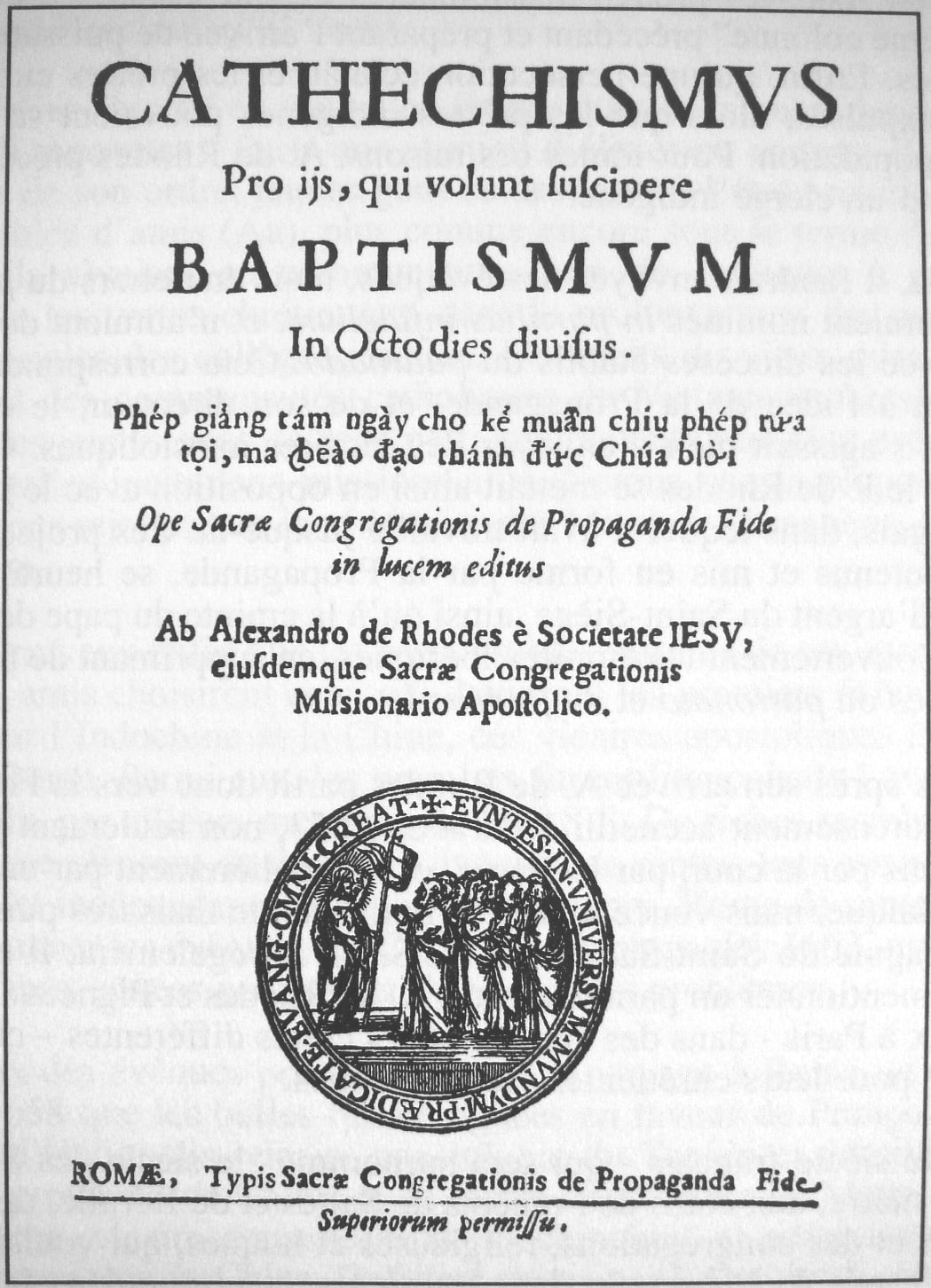
A Jesuit Prints the Vietnamese Language in the Latin Alphabet
Alexandre de Rhodes published a dictionary in Rome that fixed a Latin-letter spelling of Vietnamese, the ancestor of today’s quốc ngữ.
In 1651, the Avignonese Jesuit missionary Alexandre de Rhodes published the Dictionarium Annamiticum Lusitanum et Latinum in Rome. This trilingual dictionary, presenting Vietnamese alongside Portuguese and Latin, established in print a romanized transcription system that would eventually become modern chu Quoc ngu. Rhodes was not the sole inventor of the script. Beginning around 1620, Portuguese and Italian Jesuits, notably Francisco de Pina, had devised Latin-letter spellings to help missionaries learn spoken Vietnamese, drawing directly on earlier manuscript compilations by Gaspar do Amaral and Antonio Barbosa.
The orthography developed by these early missionaries relied heavily on Romance language conventions, particularly Portuguese spelling, alongside influences from Italian and Latin. Portuguese supplied features such as the digraph nh for a palatal nasal, and the use of gi and gh is generally thought to follow Italian practice. To capture the complex phonology of Middle Vietnamese, the system introduced special letters and diacritics. Rhodes's dictionary also used letters that later dropped out of use, such as a b with a flourish for a sound now written v.

Keep reading in Yester
Coming soonKeep following the story

Sources
- Street Cred: Alexandre de Rhodes and the Birth of Chu Quoc Ngu (Saigoneer)
- Fr de Rhodes remembered for spreading the Gospel via the romanised script of Vietnamese (AsiaNews)
- Alexandre de Rhodes entry (Jesuit Online Bibliography, Boston College)
- Universality, Modernity, and Cultural Borrowing among Vietnamese Intellectuals, 1877-1919 (Transcultural Studies, Heidelberg)
- Vietnamese Typography history (Viet Type)
- Vietnamese alphabet
Image: Alexandre_de_Rhodes · Public domain · Wikimedia Commons · cropped
