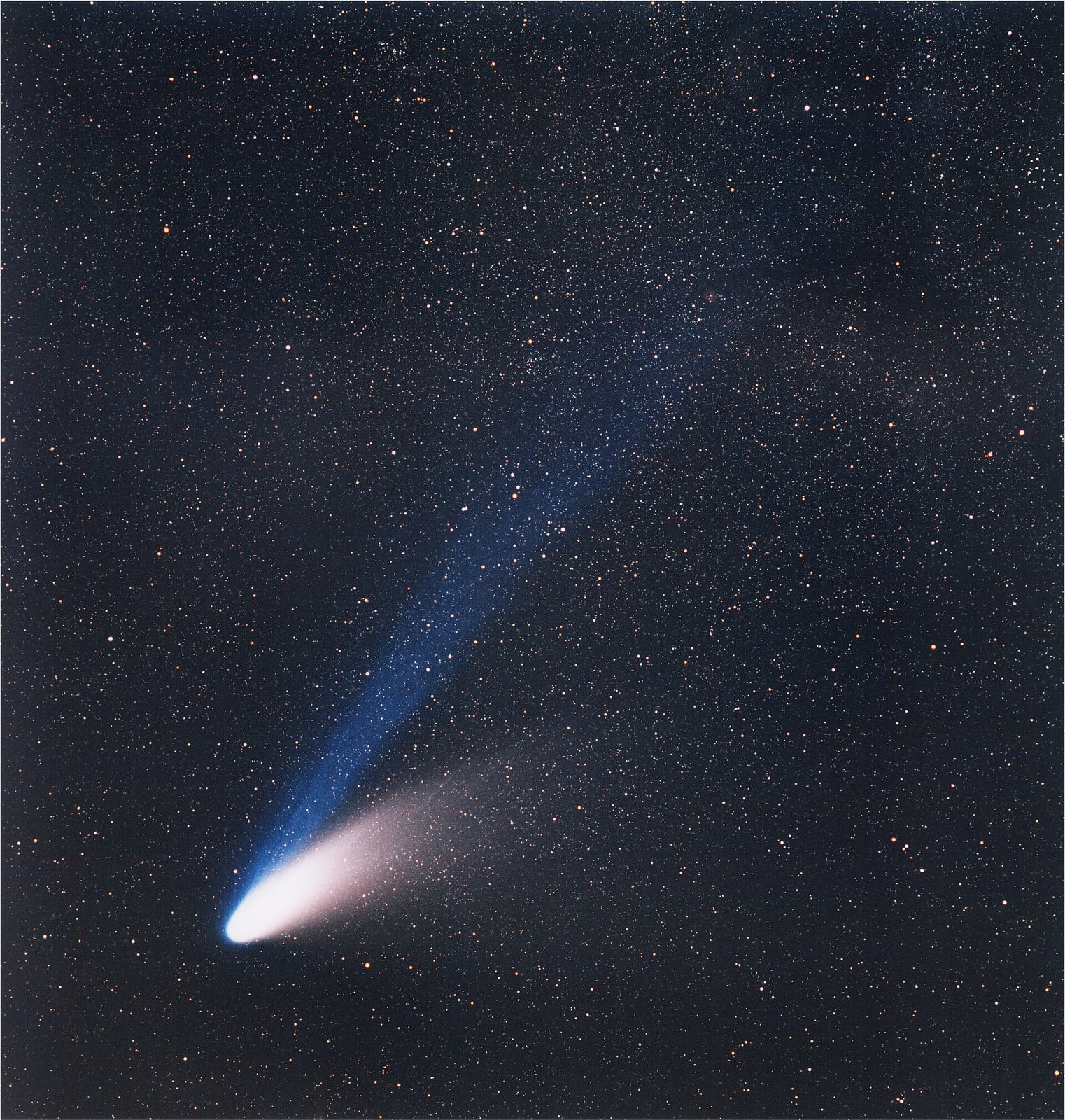
Comet Hale–Bopp Lights Up the Night Sky
One of the brightest comets of the century stayed visible to the naked eye for a record 18 months.
On July 23, 1995, two American observers working independently caught sight of a previously unrecorded comet near the globular cluster M70 in Sagittarius. Alan Hale, an experienced comet observer tracking known targets from his New Mexico driveway, noticed the moving object and sent coordinates to the Central Bureau for Astronomical Telegrams via electronic mail. At about the same time, amateur Thomas Bopp spotted the same body while looking through a friend's homemade telescope in the desert near Stanfield, Arizona, and later sent notification by Western Union telegram. The Central Bureau soon announced the discovery, and the comet was designated C/1995 O1. Orbit calculations revealed that the comet was positioned roughly 7.2 astronomical units from the Sun, an unprecedented distance for an amateur find, yet it already displayed an active, visible coma.
Earlier photographic plates taken at the UK Schmidt Telescope in 1993 had captured the faint body unnoticed at 13 astronomical units from the Sun. Subsequent analysis established that Hale–Bopp possessed an unusually massive nucleus measuring approximately 60 kilometers across, several times the size of Halley's nucleus. This extraordinary size helped explain its premature brightness at such extreme heliocentric distances. Scientists remained guarded, remembering the unpredictable behavior of past comets such as Kohoutek in 1973, which had looked promising far from the Sun only to underwhelm observers as it drew closer. Nevertheless, Hale–Bopp continued to gain intensity as it traversed the inner solar system, gradually becoming visible to the unaided human eye by May 1996.

Keep reading in Yester
Coming soonKeep following the story
Sources
- C/1995 O1 (Hale-Bopp) (NASA Science)
- March 22, 1997: Comet Hale-Bopp peaks (Astronomy magazine)
- C/1995 O1 (Hale-Bopp) (Gary W. Kronk's Cometography)
- Remembering Comet Hale-Bopp's Unlikely Discovery (Mental Floss)
- Press Release ING 4/97: sodium tail (Isaac Newton Group of Telescopes)
- Argon detected in Hale-Bopp (Spaceflight Now)
- Comet Hale-Bopp and the Total Solar Eclipse of 1997 (NASA GSFC)
- Comet Hale–Bopp
Image: ESO/E. Slawik · CC BY 4.0 · Wikimedia Commons · cropped
