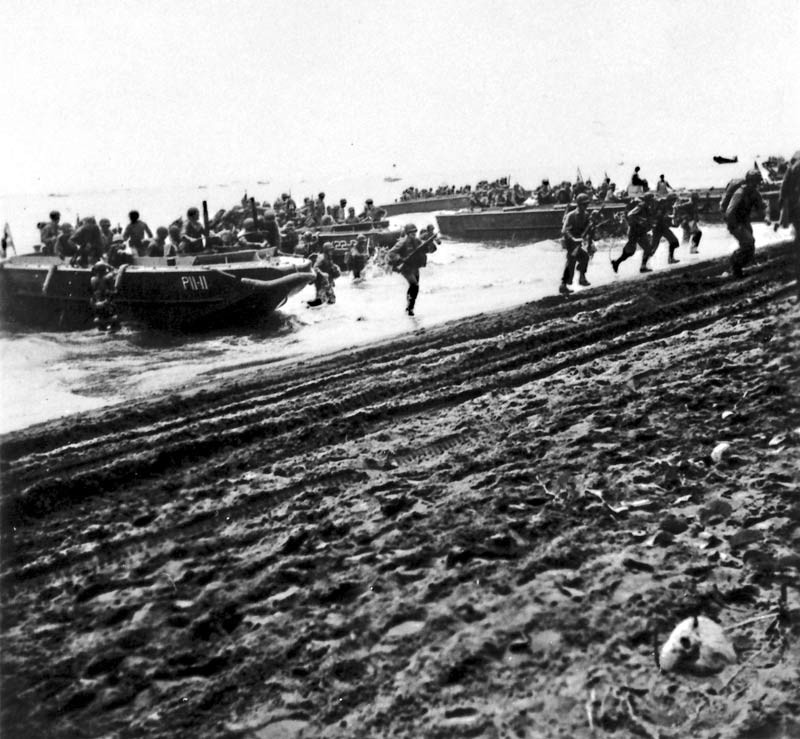
American Marines Land on Guadalcanal
The first major Allied offensive of the Pacific War began a six-month struggle for an airfield on a jungle island.
On August 7, 1942, Allied naval and amphibious forces launched Operation Watchtower, landing predominantly United States Marines on Guadalcanal, Tulagi, and Florida Island in the southern Solomon Islands. The operation represented the first major Allied land offensive against the Empire of Japan in the Pacific War. Prompted by aerial reconnaissance revealing that Japanese forces were constructing a large military airfield at Lunga Point on Guadalcanal, Allied planners sought to prevent long-range Japanese bombers from severing critical maritime supply lines running between the United States and Australia.
The initial landings achieved tactical surprise, helped according to several accounts by poor weather that shielded the approach of the invasion fleet. While small Japanese garrisons on Tulagi and adjacent islets mounted ferocious resistance before being overwhelmed, the primary landing force of eleven thousand Marines came ashore on Guadalcanal practically unopposed. Advancing westward toward Lunga Point, the Marines secured the unfinished airfield on August 8. The defenders, mostly construction personnel and supporting naval troops, retreated into the surrounding jungle, leaving behind operational heavy equipment and provisions.

Keep reading in Yester
Coming soonKeep following the story
Sources
Image: U.S. Marine Corps · Public domain · Wikimedia Commons · cropped
