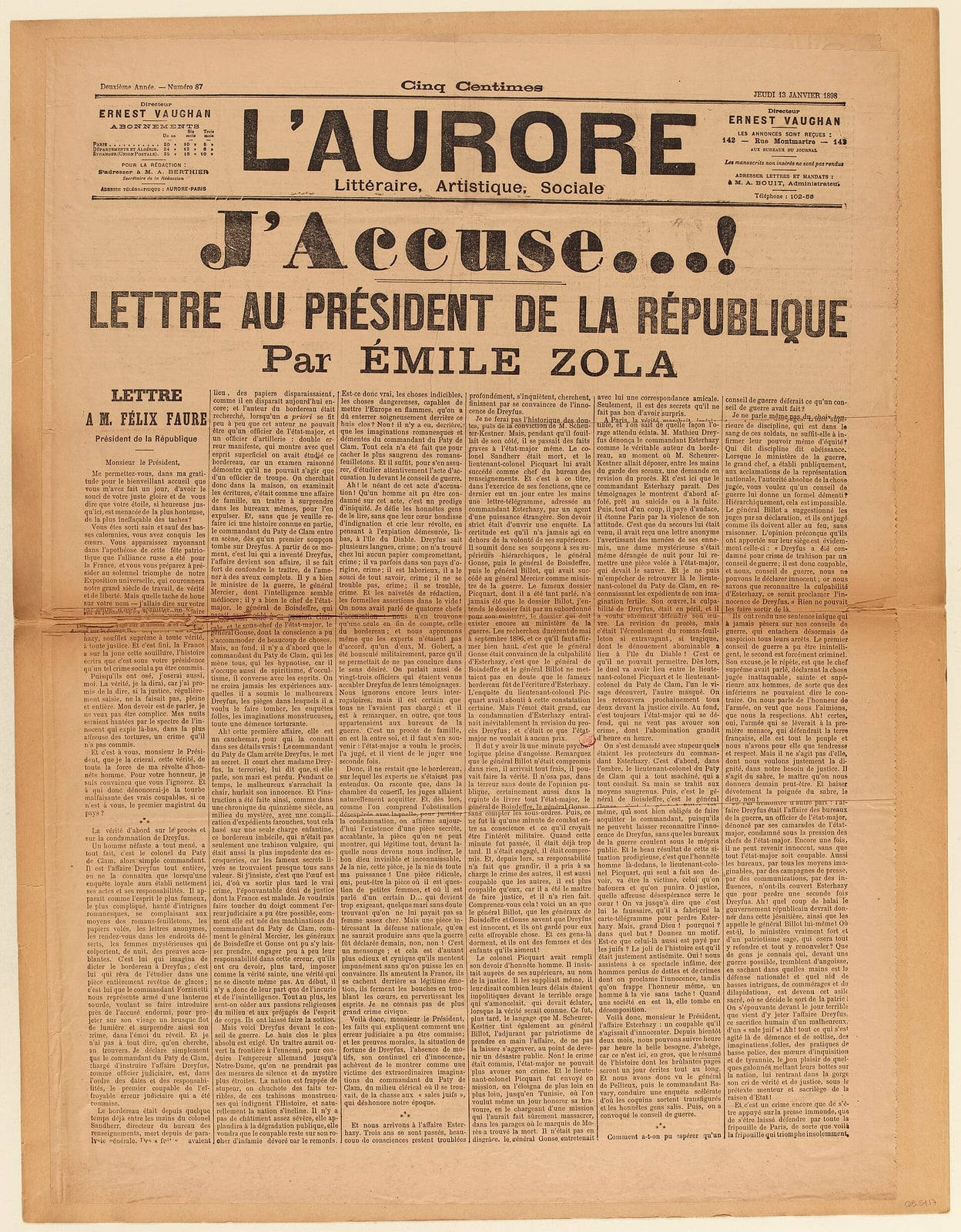
Émile Zola Publishes J’Accuse…!
A novelist’s open letter accused the French army of convicting an innocent Jewish officer and split the country.
In September 1894, a French intelligence asset working inside the German Embassy in Paris recovered an unsigned handwritten note known as the bordereau. The paper revealed that confidential French military data concerning artillery, specifically hydraulic brake mechanisms, was being offered to a foreign power. Military counterintelligence narrowed its search to artillery trainees connected to the General Staff, soon focusing on Captain Alfred Dreyfus. Dreyfus was an Alsatian artillery officer of Jewish heritage who had advanced through the republican meritocracy. Despite conflicting assessments of his handwriting, he was summoned on October 15, 1894, and arrested.
Dreyfus maintained his innocence throughout secret interrogations and a court-martial conducted behind closed doors. Convicted in December 1894 of communicating state secrets to Germany, he was sentenced to life imprisonment and transported to the penal colony on Devil's Island in French Guiana. The case ignited aggressive coverage across Paris newspapers, where antisemitic publications seized upon Dreyfus's background to justify ongoing campaigns against Jewish integration in the armed forces. For several years, military authorities treated the matter as settled.

Keep reading in Yester
Coming soonKeep following the story
Sources
- Alfred Dreyfus and the Dreyfus Affair (US Holocaust Memorial Museum Holocaust Encyclopedia)
- The Dreyfus Affair: key dates (Musée d'art et d'histoire du Judaïsme)
- Chronology of the Dreyfus Case (Jean-Max Guieu, Georgetown University)
- The Dreyfus Affair: A Chronology (Famous Trials, UMKC Law)
- Dreyfus Case (Jewish Encyclopedia)
- Dreyfus affair
Image: Zola, Emile (Paris, 02–04–1840 - Paris, 29–09–1902), auteur du texte · CC0 · Wikimedia Commons · cropped
