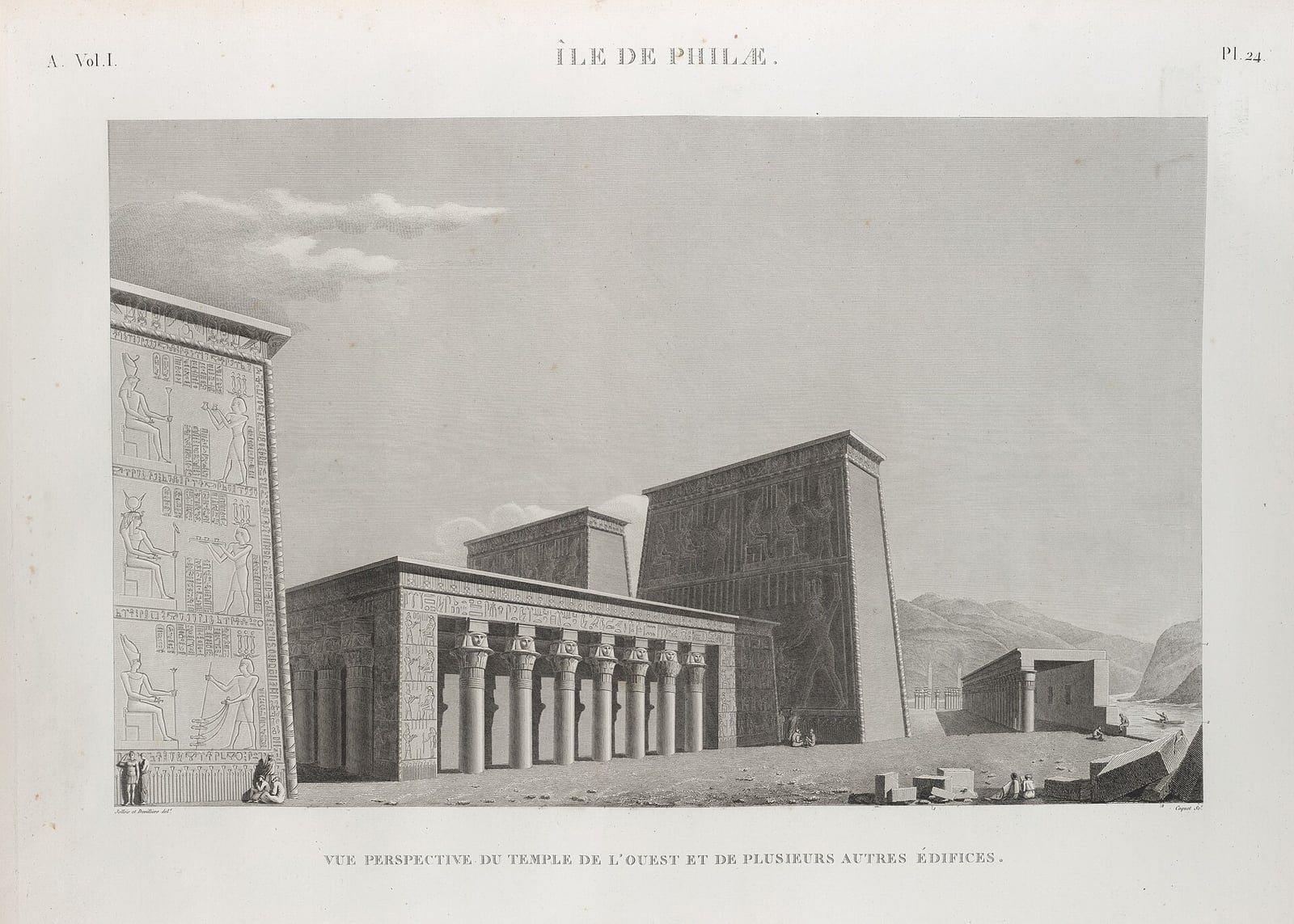
Napoleon’s Scholars Publish the Description of Egypt
The scholars who followed Napoleon’s army began publishing a vast illustrated survey of Egypt’s monuments, nature and people.
In 1809, the French imperial government issued the opening volumes of the Description de l'Égypte, initiating a massive publishing project that took two decades to complete. The collection originated in Napoleon Bonaparte's military expedition of 1798 to 1801, during which roughly 160 civilian scholars and scientists accompanied the armed forces. Organised as the Commission des Sciences et Arts d'Égypte, these researchers established the Institut d'Égypte in Cairo to investigate ancient architecture, contemporary society, and the local flora and fauna. By the time the military campaign ended, the scholars had assembled a vast repository of field notes, specimens, and drawings.
Preparing these materials for publication required an extensive bureaucratic and artistic apparatus in France. In 1802 a commission was formed to coordinate the work, with Edme-Francois Jomard coordinating its authors. The project eventually mobilized hundreds of artists and engravers, who transformed field sketches into detailed copperplate engravings. Rather than waiting for every section to be finished, the editors released volumes in stages as text and illustrations became ready, so that the work reached subscribers piece by piece over roughly two decades.

Keep reading in Yester
Coming soonKeep following the story

Sources
Image: Impr. impériale · Public domain · Wikimedia Commons · cropped
