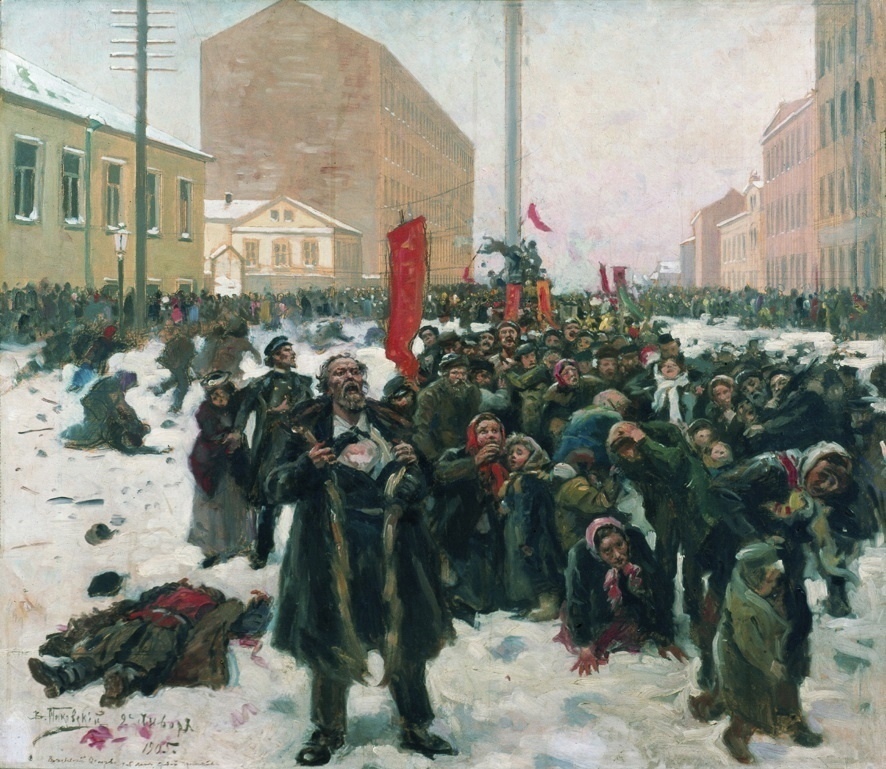
Troops Fire on Workers Marching to the Winter Palace
Soldiers shot into peaceful crowds carrying icons and a petition to Nicholas II, killing many and setting off the Revolution of 1905.
On Sunday, 22 January 1905 (9 January in the Old Style calendar), thousands of factory workers and their families gathered across the industrial outskirts of Saint Petersburg to march toward the Winter Palace. Organised by Priest Georgy Gapon, head of the Assembly of the Russian Factory and Mill Workers of the City of Saint Petersburg, the demonstrators intended to present a respectful petition directly to Tsar Nicholas II. The appeal requested an eight-hour working day, improved pay, better safety conditions, and universal suffrage. Marchers carried church banners, religious icons, and portraits of the monarch, singing hymns such as God Save the Tsar to emphasize their peaceful intentions.
The demonstration arose from deep economic tensions. Following the 1861 emancipation of the serfs, an urban working class had formed under intense factory discipline, working days that commonly ran past twelve hours in dangerous conditions. The dismissal of several workers at the Putilov Ironworks provoked a strike that began in mid-January 1905 and soon drew in well over 100,000 labourers across the city's factories. By the eve of the march, Saint Petersburg had lost both electricity and newspapers. The workers, generally loyal to the autocracy and indifferent to underground revolutionary factions, believed their sovereign would address their plight once properly informed.

Keep reading in Yester
Coming soonKeep following the story
Sources
- Bloody Sunday in 1905 (World History Encyclopedia)
- Gapon, Georgy Apollonovich (Encyclopedia.com)
- Bloody Sunday in St Petersburg (History Today)
- Documents on the 1905 Russian Revolution (Marxists Internet Archive)
- Bloody Sunday (1905) (New World Encyclopedia)
- Bloody Sunday 1905 (History of Royal Women)
- Bloody Sunday (1905)
Image: Vladimir Makovsky · Public domain · Wikimedia Commons · cropped
