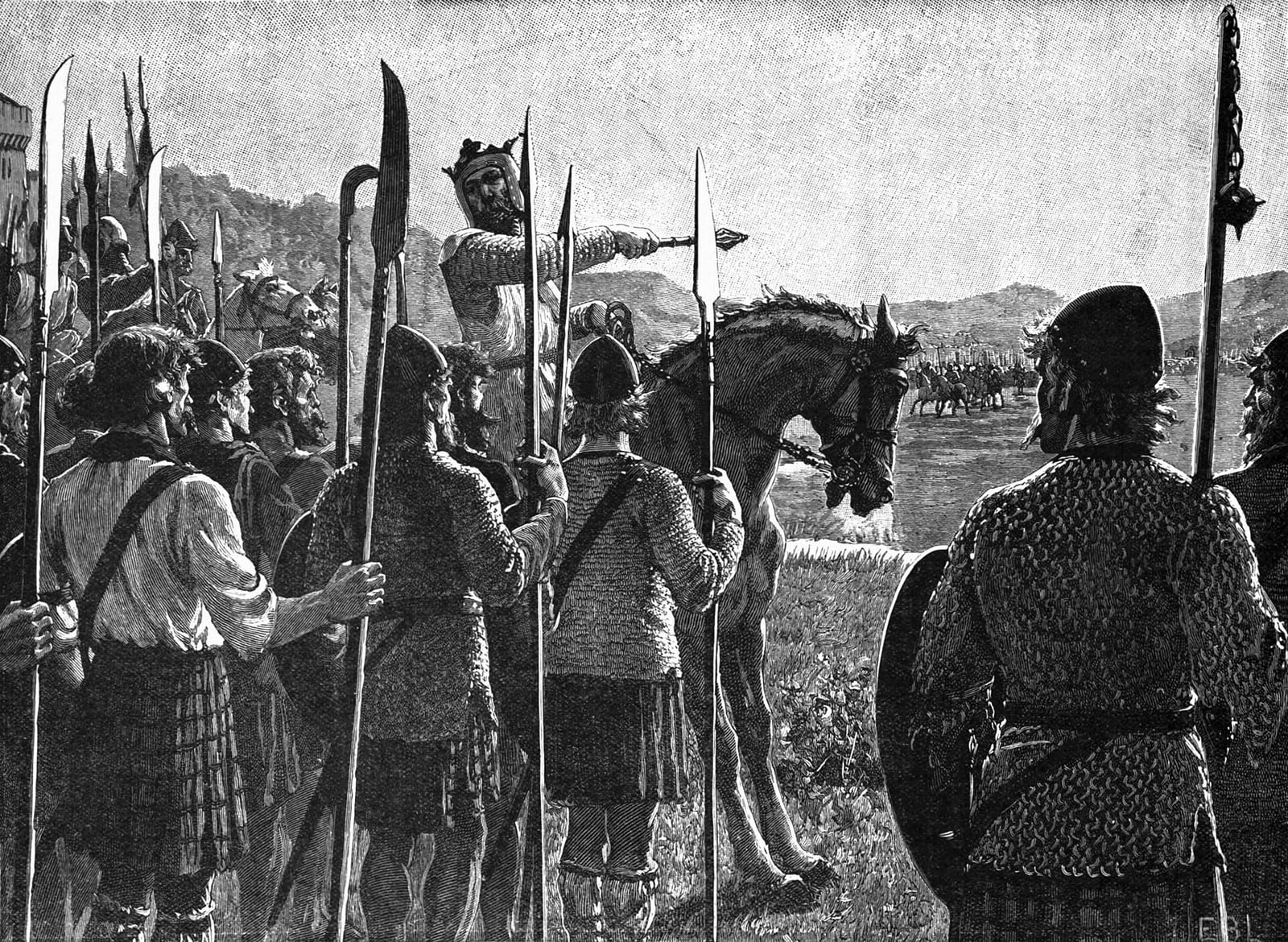
Robert the Bruce Defeats England at Bannockburn
A smaller Scottish army routed Edward II in a two-day battle that secured Bruce’s throne.
In the summer of 1314, a massive English army marched north into Scotland under King Edward II, determined to break the Scottish siege of Stirling Castle. The fortress guarded the primary passage into the Scottish Highlands and was scheduled to surrender if English forces failed to relieve it by midsummer. Robert the Bruce, King of Scots since 1306, stationed his troops across the southern approaches near the stream known as the Bannockburn. Though Edward had summoned thousands of infantry and heavy cavalry from England, Ireland, and Wales, modern estimates put Bruce's force at about 6,000 to 7,000 spearmen and some 500 light horse, facing an English army perhaps two to three times larger.
Combat commenced on 23 June when English advance forces approached the Scottish positions in the woodland of New Park. In a famous encounter, the English knight Sir Henry de Bohun charged Bruce, who was lightly armoured and riding a small horse. Bruce evaded the strike and killed Bohun with his battle axe, an act that lifted Scottish spirits. A simultaneous English attempt to flank the Scots and reach Stirling Castle was beaten back by Scottish spearmen under Thomas Randolph, Earl of Moray. Sir Thomas Grey was captured during the encounter, and the thwarted English columns fell back across the Bannockburn to encamp in low-lying, marshy ground.

Keep reading in Yester
Coming soonKeep following the story
Sources
Image: Edmund Blair Leighton · Public domain · Wikimedia Commons · cropped
