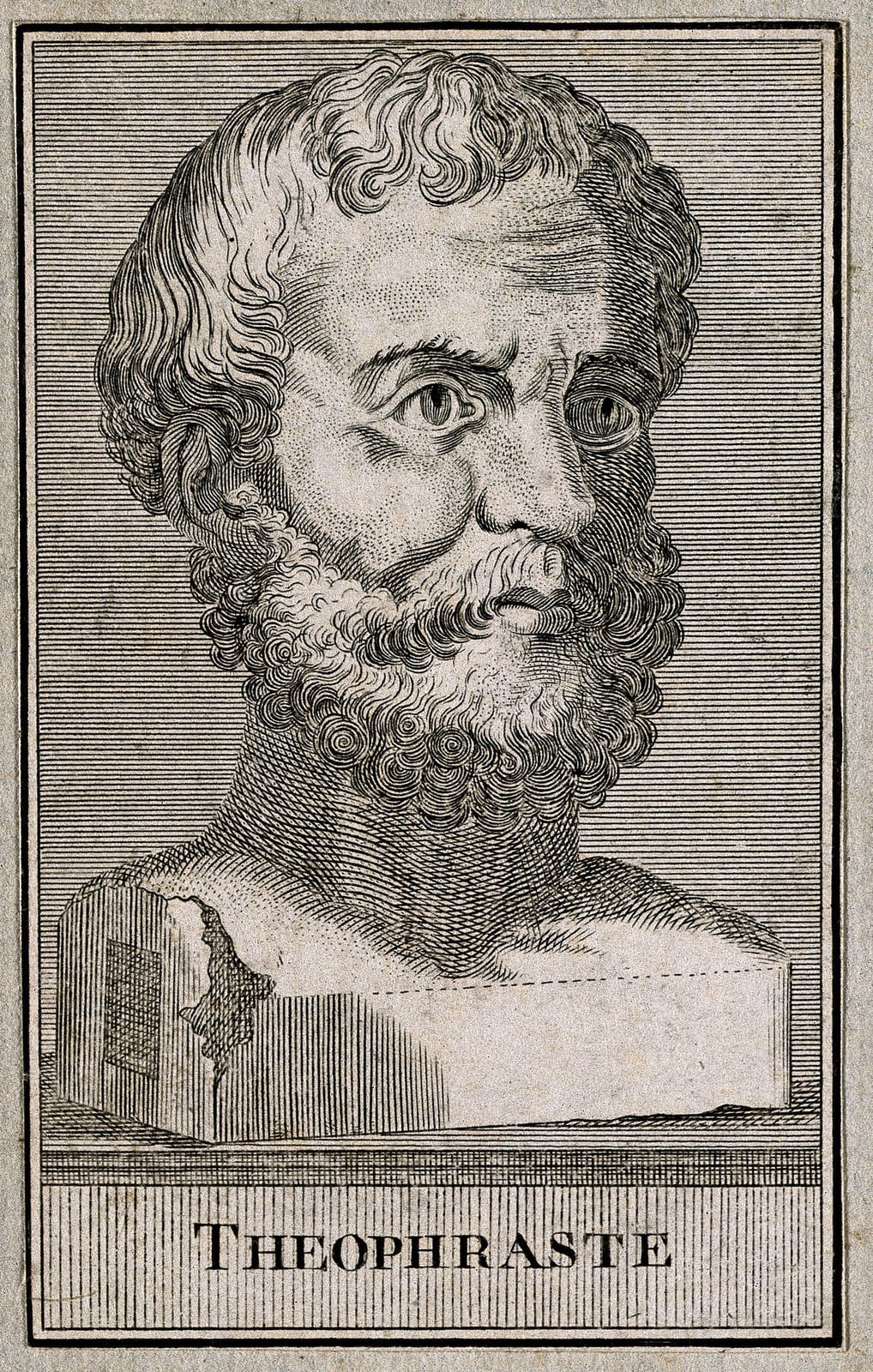
Theophrastus Writes the First Great Book of Botany
Aristotle’s successor classified some 500 plants by how they grow, earning the title of father of botany.
Between roughly 350 and 287 BCE, the Greek philosopher Theophrastus assembled the extensive lecture notes that formed Historia Plantarum, or Enquiry into Plants. Theophrastus, who succeeded Aristotle as head of the Peripatetic school in Athens, arranged the work in ten books, of which nine have survived into the modern era. Rather than preparing a polished manuscript for recreational reading, Theophrastus maintained an evolving working text designed for his students at the Lyceum. He incorporated teachings preserved in the school library, including fragments from Democritus, while systematically observing the natural world around him.
Theophrastus structured his investigation along lines similar to the animal inquiries conducted by his mentor, Aristotle. He described roughly five hundred kinds of plants, dividing them broadly into trees, shrubs, undershrubs, and herbaceous plants, while distinguishing wild types from cultivated varieties. In doing so, he developed an early biological classification based on structure and methods of propagation. The historian Roger French has argued that he went beyond Aristotle by treating seeds as parts of the plant, whereas Aristotle would never have called semen or embryos parts of an animal.

Keep reading in Yester
Coming soonKeep following the story
Sources
- Theophrastus (Trinity College Dublin, School of Natural Sciences)
- Theophrastus (EBSCO Research Starters)
- Theophrastus and early botany (Edward Worth Library)
- The Treatises of Theophrastus (Muséum national d'Histoire naturelle, OpenEdition Books)
- Order from Chaos: the botanical tradition (Hunt Institute for Botanical Documentation)
- Historia Plantarum (Theophrastus)
Image: Unidentified engraver · CC BY 4.0 · Wikimedia Commons · cropped
