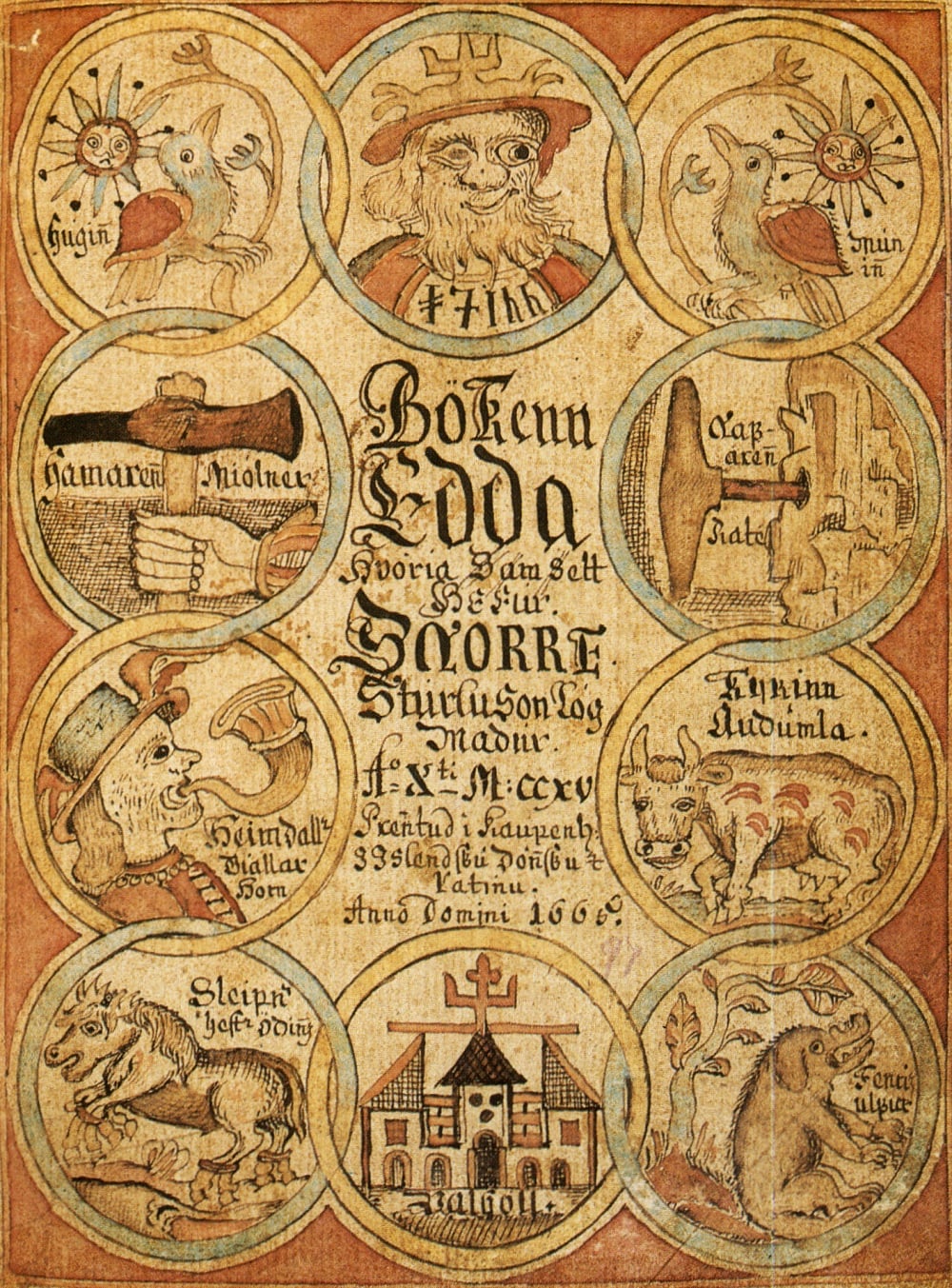
Snorri Sturluson Writes Down the Old Norse Gods
The Icelandic chieftain Snorri Sturluson wrote the Prose Edda, a handbook for poets that preserves much of what is known of Norse mythology.
Around 1220, the Icelandic scholar, lawspeaker, and historian Snorri Sturluson compiled an Old Norse handbook that became known as the Prose Edda. Produced during a period of transition in medieval Iceland, the text was designed primarily as a textbook for poets rather than a sacred scripture. Its practical goal was to guide readers and aspiring bards through the intricacies of traditional alliterative verse and to explain the mythological references embedded within complex skaldic metaphors.
The Prose Edda is organized into four distinct sections. It opens with a Prologue offering a euhemerized account of Norse paganism, presenting the gods not as genuine deities, but as human leaders from Asia, linked in the account to the royal line of Troy. This framing reflects medieval Christian scholarship, which often explained ancient mythologies as distorted history. Scholars debate whether Snorri himself wrote the Prologue. This introduction prepared readers to appreciate pagan poetic lore without compromising Christian doctrine.

Keep reading in Yester
Coming soonKeep following the story
Sources
- Snorres Edda (Store norske leksikon)
- Prose Edda / Edda (World History Encyclopedia)
- Snorra Edda (Northern Tales)
- Edda Islandorum, first printed edition notes (Skaldic Poetry of the Scandinavian Middle Ages)
- Reykholt and the Home of Snorri Sturluson (Archaeology Travel)
- Gylfaginning, The Deluding of Gylfi (Harvard ECT)
- Prose Edda
Image: Unknown author · Public domain · Wikimedia Commons · cropped
