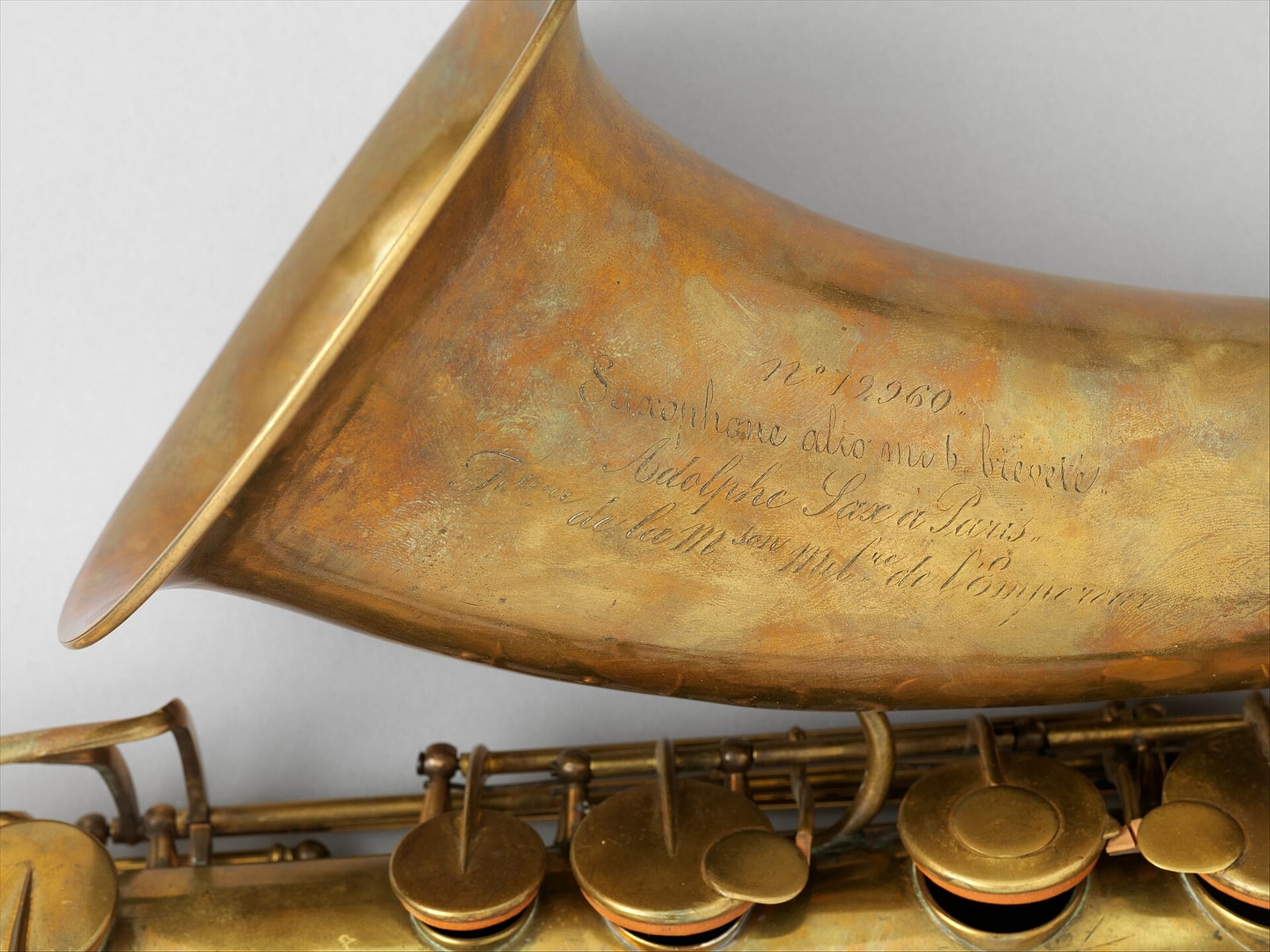
Adolphe Sax Patents the Saxophone
A Belgian instrument maker built a brass horn with a reed that would become the voice of jazz.
On 28 June 1846, Belgian instrument maker Adolphe Sax received a fifteen-year French patent for a novel woodwind instrument crafted from brass. Born in Dinant and originally based in Brussels, Sax had moved to Paris in 1842 to establish his musical enterprise. He had already acquired deep technical skill refining the bass clarinet and constructing the ophicleide, an obsolete keyed brass instrument. Drawing on that background, Sax set out to build an instrument that combined the acoustic power and projection of brass with the agile fingerwork of a woodwind, producing sound by attaching a single reed to a conical metal tube.
Unlike the cylindrical clarinet, which overblows at the twelfth, Sax designed his conical horn to overblow at the octave, giving it matching fingering across both principal registers. His 1846 patent outlined fourteen versions spanning from sopranino to contrabass, arranged into two distinct families: one pitched in C and F for orchestral purposes, and another pitched in B-flat and E-flat for military bands. While the orchestral series never gained widespread favor, the B-flat and E-flat models established the standard that endured across the subsequent century.

Keep reading in Yester
Coming soonKeep following the story
Sources
- The invention of the saxophone by Adolphe Sax (Henri Selmer Paris)
- Marcel Mule (Henri Selmer Paris)
- Saxophone, 19th and 20th century (Historisches Museum Basel)
- The Saxophone (University of Illinois, Imperfect Sax exhibit)
- Conn Saxophones: A History (SaxGourmet)
- Coleman Randolph Hawkins (The Syncopated Times)
- The saxophone #OnThisDay (The Orkney News)
- Saxophone
Image: Adolphe Sax · CC0 · Wikimedia Commons · cropped
