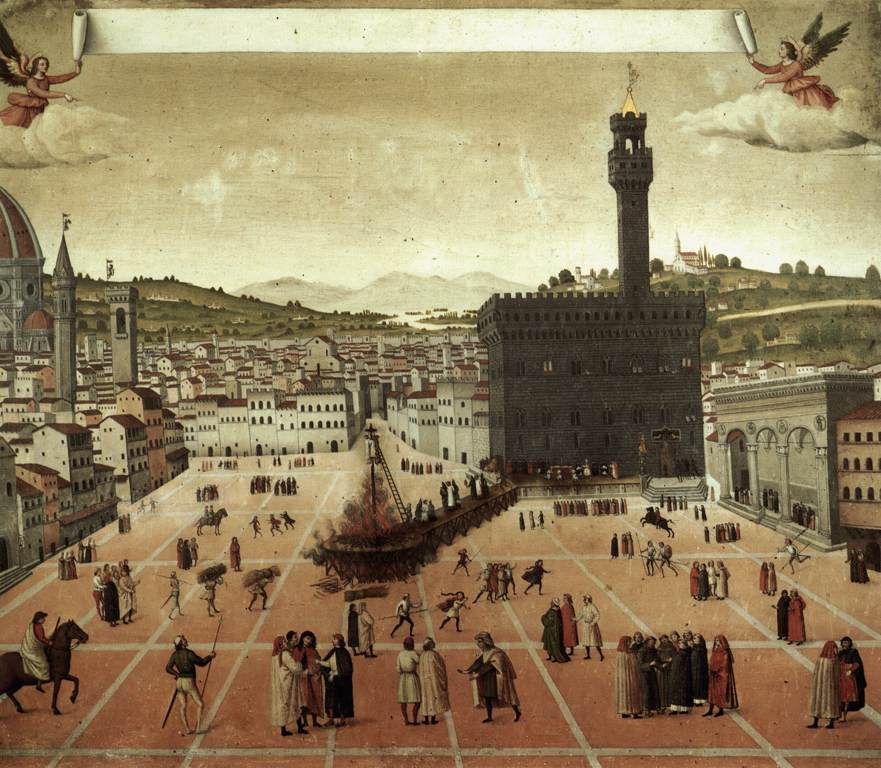
Savonarola’s Followers Burn the Vanities of Florence
Followers of the friar Girolamo Savonarola burned mirrors, cosmetics, cards and art in the city’s main square, and in 1498 he was executed in the same square.
On Shrove Tuesday, 7 February 1497, crowds assembled in the public square of Florence to watch the destruction of thousands of personal belongings deemed sinful by religious authorities. Followers of Girolamo Savonarola, an ascetic Dominican friar, piled cosmetic preparations, mirrors, fine dresses, playing cards, dice, musical instruments, and secular song sheets into a vast pyre. Alongside everyday luxuries lay literary works deemed corrupting, such as works by Giovanni Boccaccio, as well as paintings. This collective burning came to be known as the bonfire of the vanities.
Although the 1497 event in Florence remains the most famous incident bearing that label, such pyres were not unprecedented. During the opening decades of the fifteenth century, San Bernardino di Siena had at times accompanied his open-air preaching with public burnings of cards, games and other items associated with vice. Savonarola adapted this established practice to the political and spiritual tensions of late fifteenth-century Florence, transforming penitential spectacle into an instrument of civic reform.

Keep reading in Yester
Coming soonKeep following the story
Sources
Image: attributed to Francesco Rosselli (this image possibly of an early modern copy) · Public domain · Wikimedia Commons · cropped
