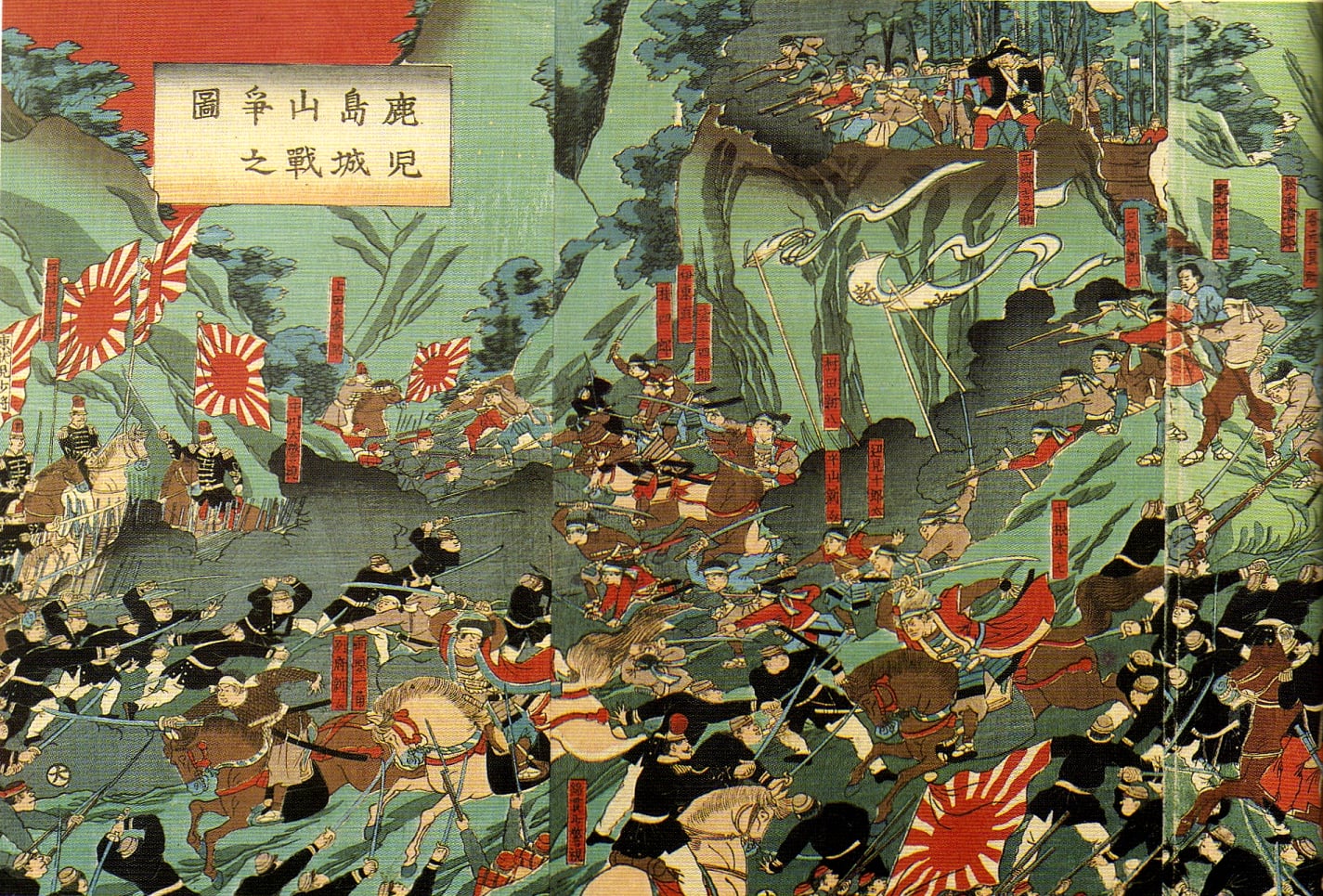
Saigō Takamori’s Samurai Make a Last Stand at Shiroyama
The last great samurai rising ended when the new conscript army of Meiji Japan overwhelmed Saigō Takamori and his followers at Kagoshima.
In the early hours of September 24, 1877, imperial artillery and offshore warships opened fire on the fortified hill of Shiroyama overlooking Kagoshima. Encircled by a modern army outnumbering them heavily, by about sixty to one in one estimate, roughly forty surviving samurai led by Saigō Takamori faced inevitable annihilation. The assault concluded the Satsuma Rebellion, an eight-month civil war that served as the final armed uprising against the radical transformations of the Meiji government. When Saigō was struck and mortally injured by gunfire, his associate Beppu Shinsuke, according to most accounts, beheaded him to avert capture, before the remaining fighters charged downhill into the imperial lines.
The roots of the conflict lay in the foundational policies of the Meiji state, which had dismantled the traditional feudal order following the Tokugawa shogunate's collapse. Although the Satsuma Domain had been central to the restoration, sweeping modernizing reforms abolished the exclusive privileges of the samurai class and revoked their customary stipends. Saigō, a prominent leader during the restoration struggles, resigned from the central administration in 1873 after his proposal to mount an expedition against Korea was rejected. Retiring to Kagoshima, he established a network of private academies known as the Shi-gakkō, where thousands of disaffected former warriors studied academic texts while undergoing rigorous weapons drills and artillery practice.

Keep reading in Yester
Coming soonKeep following the story
Sources
Image: Mosai Nagashima (Yoshitora Utagawa) · Public domain · Wikimedia Commons · cropped
