Samalas Erupts and Buries a Royal City on Lombok
Scientists traced a mystery spike in polar ice to an Indonesian volcano that destroyed the capital Pamatan.
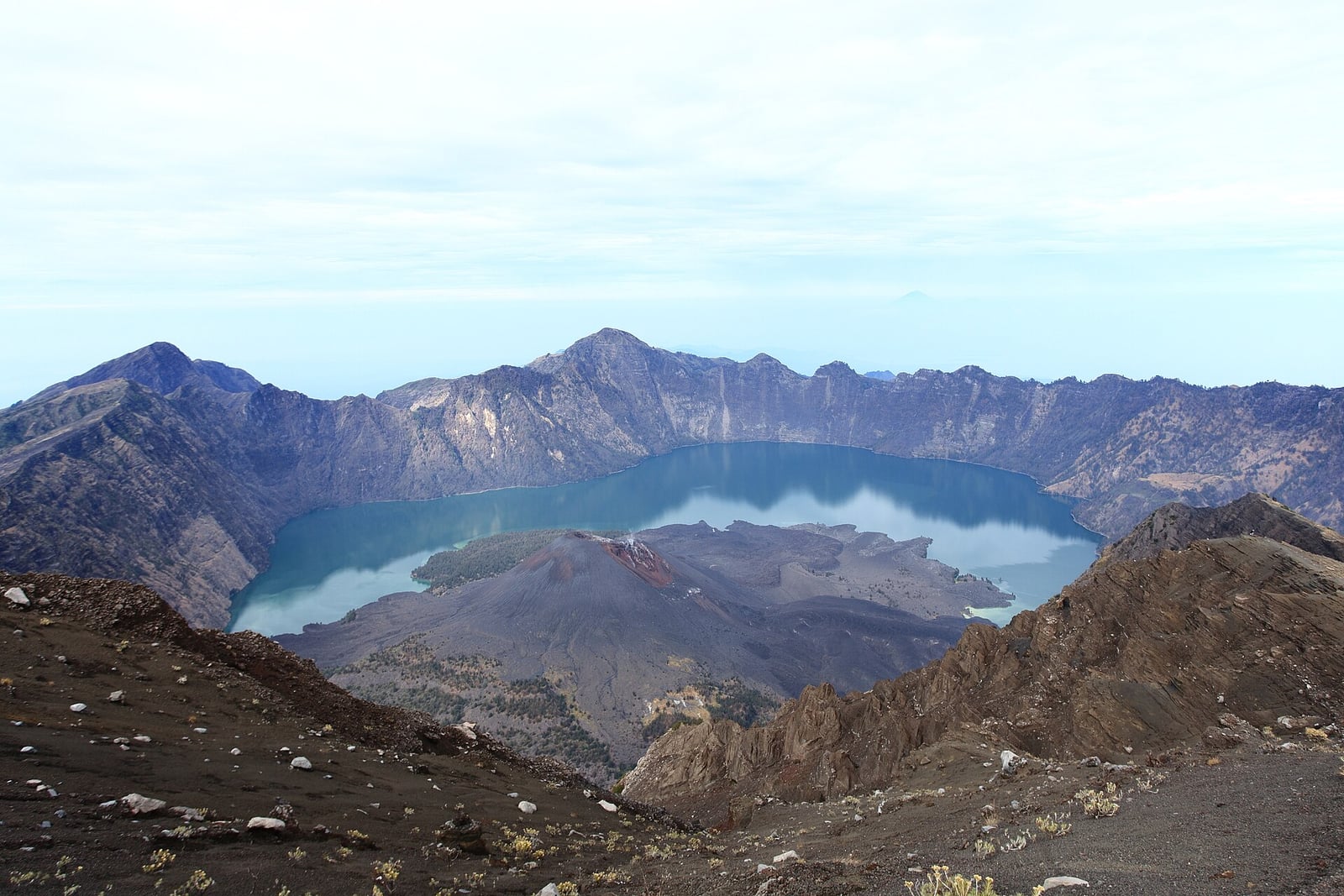
In 1257, a tremendous volcanic explosion tore apart Mount Samalas on the Indonesian island of Lombok. With an estimated magnitude of 7, the blast ranks as one of the largest eruptions of the Holocene epoch. Before the disaster, Samalas may have risen about 4,200 meters above sea level, surpassing its modern neighbor Mount Rinjani. The cataclysm utterly destroyed this ancient peak, collapsing its bulk into a massive depression now known as the Segara Anak caldera, within which a two-hundred-meter-deep lake formed.
The eruption unfolded in distinct phases, driving immense eruption columns up to about forty-three kilometers high into the stratosphere. Boiling pyroclastic flows swept across the island, burying river valleys, incinerating vegetation, and leaving deposits up to 35 meters thick at the coast 25 kilometers from the volcano. Ash fell across Lombok and the neighboring islands of Bali and Sumbawa and most likely reached eastern Java. On Lombok itself, the catastrophic flows obliterated human settlements, including Pamatan, the capital city of a local kingdom.

Keep reading in Yester
Coming soonKeep following the story
Sources
- Source of the great A.D. 1257 mystery eruption unveiled, Samalas volcano, Rinjani Volcanic Complex, Indonesia, Lavigne et al. 2013 (PNAS, via PubMed Central)
- The 1257 Samalas eruption (Lombok, Indonesia): the single greatest stratospheric gas release of the Common Era, Vidal et al. 2016 (Scientific Reports, via Europe PMC)
- Scientists may have source for A.D. 1257 mystery eruption (NPR, via GBH News)
- The 1257 eruption investigation (CNRS News)
- 1257 Samalas eruption
Image: skyseeker · CC BY 2.0 · Wikimedia Commons · cropped
