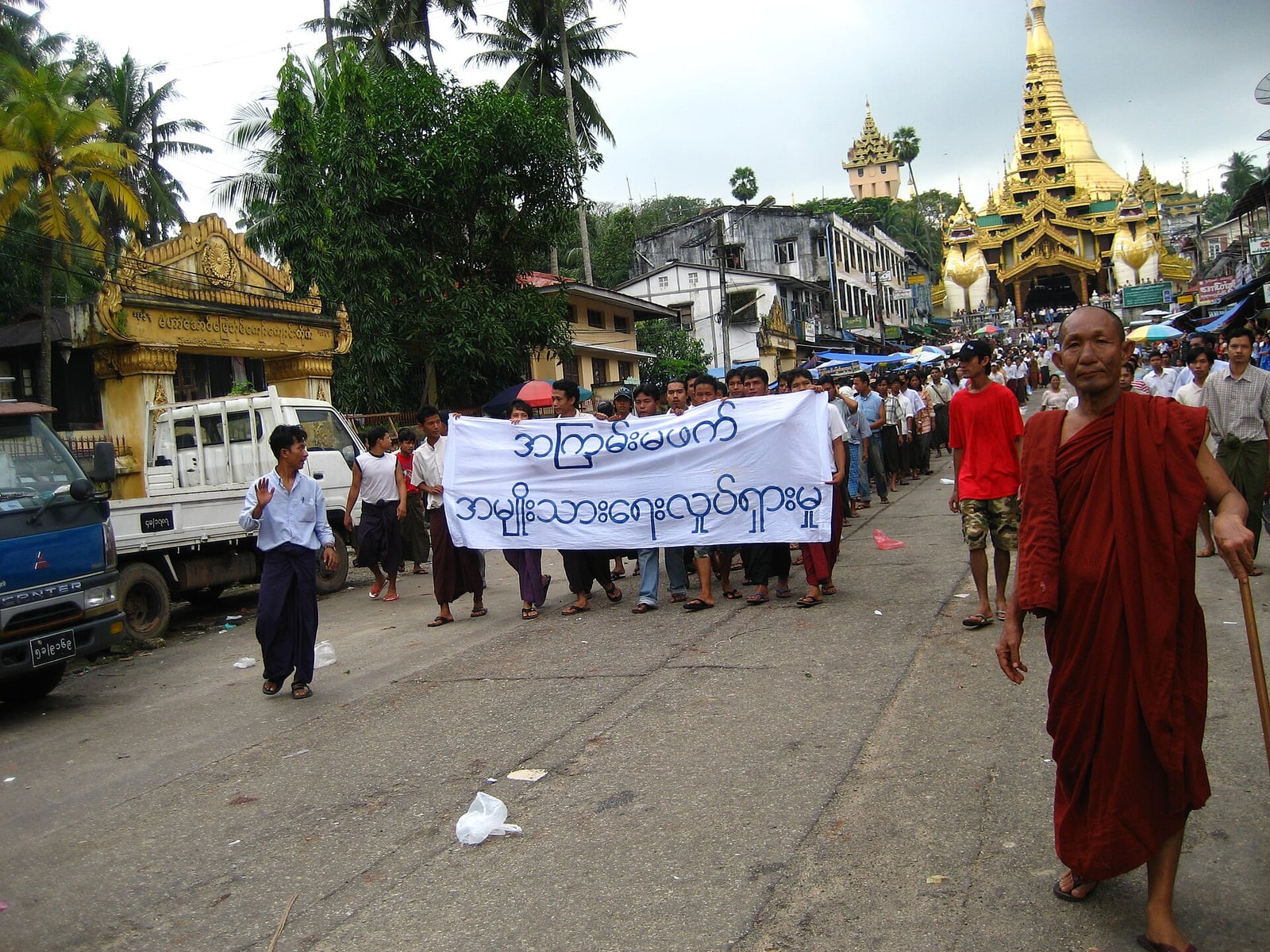
Buddhist Monks Lead Protests Against Myanmar’s Junta
Tens of thousands of monks marched against fuel price rises before soldiers raided monasteries and fired on crowds.
On 15 August 2007, Myanmar's military government, the State Peace and Development Council, abruptly eliminated retail fuel subsidies without prior public notice. According to Human Rights Watch, fuel and diesel prices roughly doubled overnight, while the price of natural gas used by buses rose by as much as 500 percent. In a desperately poor country, the steep rise in transport costs immediately drove up the price of basic goods, including rice, and put bus travel out of reach for many.
Small demonstrations against the economic shock began on 19 August, led initially by political activists and student groups. The military authorities responded quickly by beating demonstrators and arresting prominent dissident figures, including leaders from the 88 Generation Students group. When security forces violently broke up a march by several hundred monks in the central town of Pakokku on 5 September, beating monks in public, the nature of the resistance changed. The next day, monks and local residents held visiting officials inside a Pakokku monastery for about six hours, and a new All Burma Monks Alliance gave the government until 17 September to apologize. The government ignored the deadline, prompting monks across Myanmar to organize nonviolent marches and enact a religious boycott by refusing spiritual services to members of the armed forces.

Keep reading in Yester
Coming soonKeep following the story
Sources
- Crackdown: Repression of the 2007 Popular Protests in Burma (Human Rights Watch)
- Myanmar crackdown toll put at 31 (Al Jazeera)
- Japanese photographer killed as Burmese troops crack down on protests (Committee to Protect Journalists)
- U Gambira to serve total of 68 years in prison (Burma News International)
- Saffron Revolution
Image: racoles · CC BY 2.0 · Wikimedia Commons · cropped
