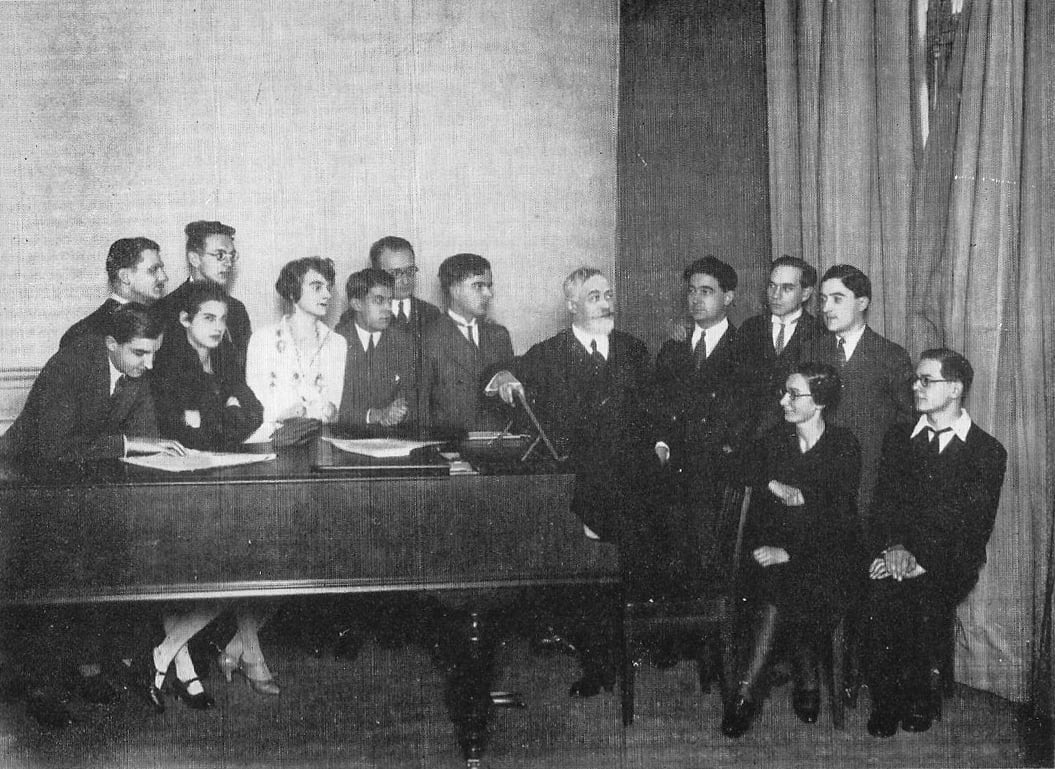
Messiaen Premieres a Quartet in a Prisoner-of-War Camp
Olivier Messiaen wrote his Quartet for the End of Time for the instruments of fellow prisoners in Stalag VIII-A.
On January 15, 1941, hundreds of prisoners of war and German guards gathered inside Stalag VIII-A, a military camp located in Görlitz, Germany, to attend the premiere of an unusual piece of chamber music. Drafted into the French army as a medical auxiliary when World War II began, the thirty-one-year-old French composer Olivier Messiaen had been captured during the German invasion of 1940 and sent to the Silesian camp. Deprived of normal civilian resources, he set about writing an expansive work shaped directly by the specific instrumental talents available among his fellow captives.
The unusual instrumentation of the piece, scored for clarinet, violin, cello, and piano, arose from practical circumstance rather than theoretical planning. While in transit to the camp, Messiaen shared initial sketches with the clarinetist Henri Akoka. Messiaen had already met cellist Étienne Pasquier at Verdun before their capture, and in Stalag VIII-A the two were joined by violinist Jean le Boulaire. A sympathetic German guard, Karl-Albert Brüll, provided Messiaen with music paper, pencils and quiet time to work, and helped the musicians obtain instruments. Messiaen initially composed a trio for the three string and woodwind players before adding a piano part for himself to play, expanding the core material into an eight-movement suite lasting roughly fifty minutes.

Keep reading in Yester
Coming soonKeep following the story
Sources
Image: Unknown author · Public domain · Wikimedia Commons · cropped
