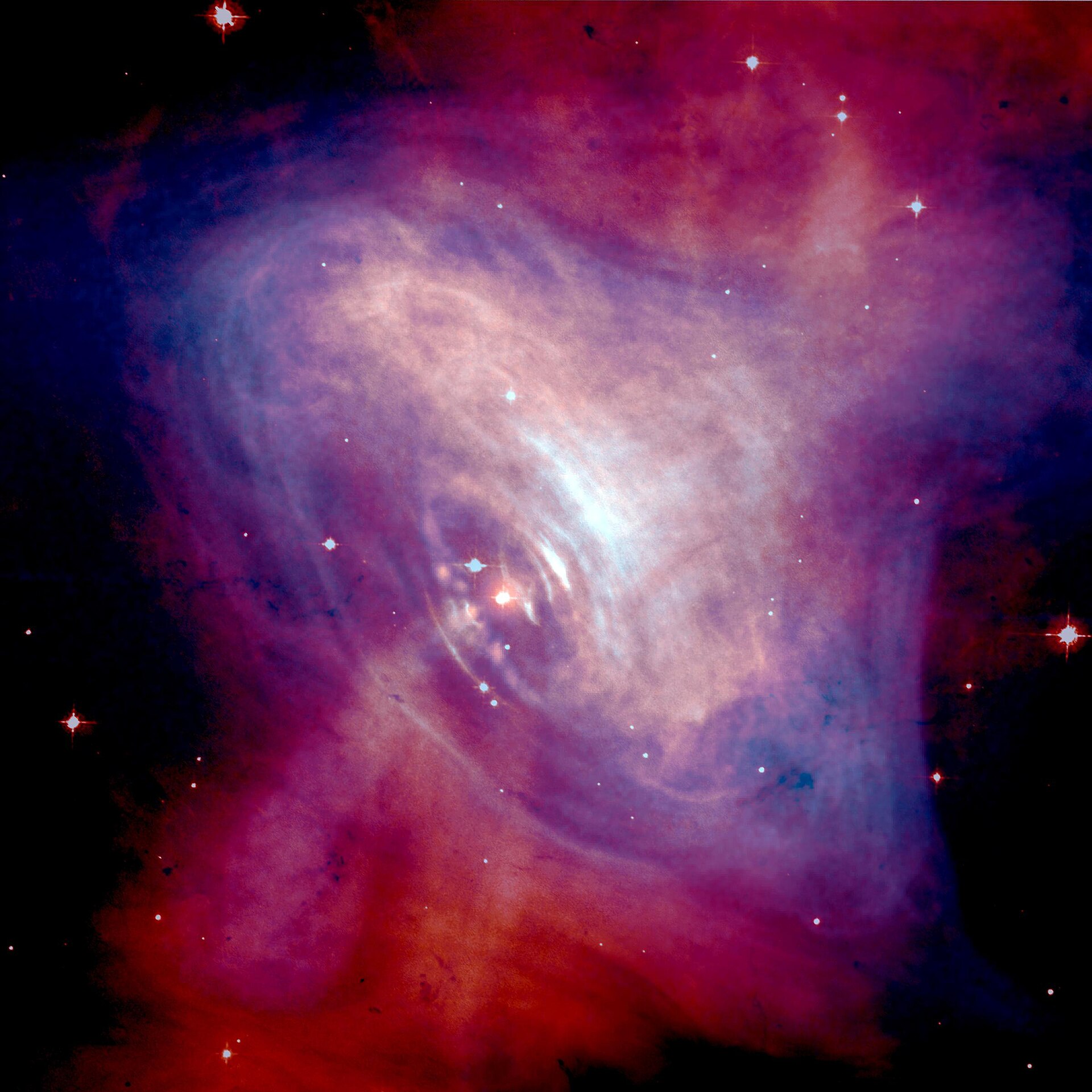
A Graduate Student Discovers the First Pulsar
Jocelyn Bell noticed a regular radio pulse in her chart paper that turned out to come from a spinning neutron star.
On about 28 November 1967, a fast chart recorder at the Mullard Radio Astronomy Observatory near Cambridge captured the unusual signal that Northern Irish postgraduate researcher Jocelyn Bell had been tracking for months. She had spent the previous two years helping assemble the Interplanetary Scintillation Array, an expansive radio telescope designed by her doctoral supervisor Antony Hewish to monitor quasars. Bell inspected chart recorder rolls by hand, examining miles of paper tracking radio sources across the sky, working through roughly thirty meters of chart paper each day. In August, amid the recorded noise, she had noticed a faint, flickering trace she called scruff, and she found that it returned at the same sidereal time, moving with the stars rather than with local terrestrial time.
After she raised the trace with Hewish in late August, a faster chart recorder was installed, but the source then failed to appear for weeks. When it returned in late November, the new recording showed that it was not random static, but a series of short pulses repeating about every 1.337 seconds. The source was jokingly nicknamed LGM-1, for Little Green Men, reflecting playful speculation about potential extraterrestrial origins, before further astrophysical study established that the emission came from a natural, rapidly rotating neutron star, later designated PSR B1919+21.

Keep reading in Yester
Coming soonKeep following the story
Sources
- The SETI Episode in the 1967 Discovery of Pulsars (Penny, arXiv/European Physical Journal H)
- Jocelyn Bell Burnell (EBSCO Research Starters)
- Tick Tock, Pulsating Star (NRAO)
- Professor Jocelyn Bell Burnell wins Special Breakthrough Prize (Royal Astronomical Society)
- Top astronomer donates £2.3 million prize to young physicists (Times Higher Education)
- Me by Dame Jocelyn Bell Burnell (University of Glasgow Avenue)
- Jocelyn Bell Burnell, Scientist of the Day (Linda Hall Library)
- Jocelyn Bell Burnell
Image: Optical: NASA/HST/ASU/J. Hester et al. X-Ray: NASA/CXC/ASU/J. Hester et al. · Public domain · Wikimedia Commons · cropped
