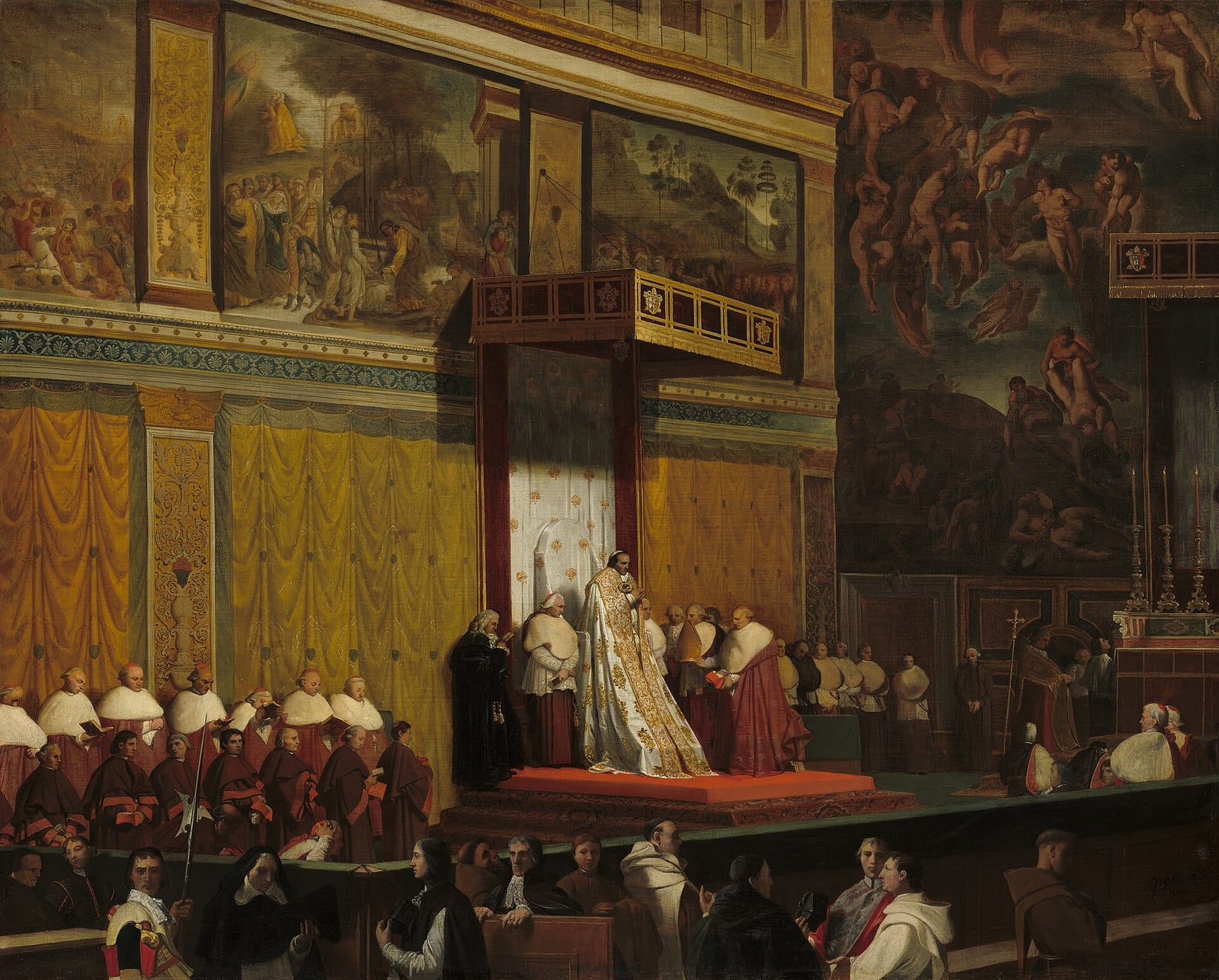
Allegri’s Miserere Becomes the Sistine Chapel’s Guarded Secret
Legend said the Vatican guarded the setting until the 14-year-old Mozart wrote it down from memory in 1770, though copies already circulated.
During the 1630s, under the papacy of Urban VIII, the Italian composer Gregorio Allegri composed a choral setting of Psalm 51, titled Miserere mei, Deus. Intended specifically for Holy Week services held during Tenebrae at the Sistine Chapel, the piece continued a Vatican tradition of falsobordone settings that reached back to at least 1514. Allegri organized the work around the liturgical tonus peregrinus, alternating chant with polyphony. In his arrangement, a choir of five voices and a choir of four voices alternate across the psalm verses, with plainchant interspersed between them, before joining together in a final nine-part polyphonic conclusion.
Over time, an enduring aura of secrecy formed around the composition. Traditional accounts asserted that the Vatican strictly controlled access to the score, prohibiting unauthorized transcription under threat of severe church penalties, with supposedly only three legitimate copies distributed abroad to figures such as Emperor Leopold I, the King of Portugal, and the scholar Padre Martini. Yet historical documentation contradicts this strict narrative. Transcriptions were available across Rome, and the work circulated internationally long before the late eighteenth century. In London, for example, documented performances date back to roughly 1735, and by the 1760s the Academy of Ancient Music performed the piece routinely.

Keep reading in Yester
Coming soonKeep following the story
Sources
- Allegri's Miserere: theories (Ben Byram-Wigfield, Ancient Groove Music)
- Introduction: myth and reality, in Allegri's Miserere in the Sistine Chapel (Graham O'Reilly, Cambridge University Press)
- Music History Monday: One Talented Kid (Robert Greenberg)
- Mozart was knighted as a teenager (BBC Music Magazine, classical-music.com)
- Miserere (Allegri)
Image: Jean-Auguste-Dominique Ingres · CC0 · Wikimedia Commons · cropped
