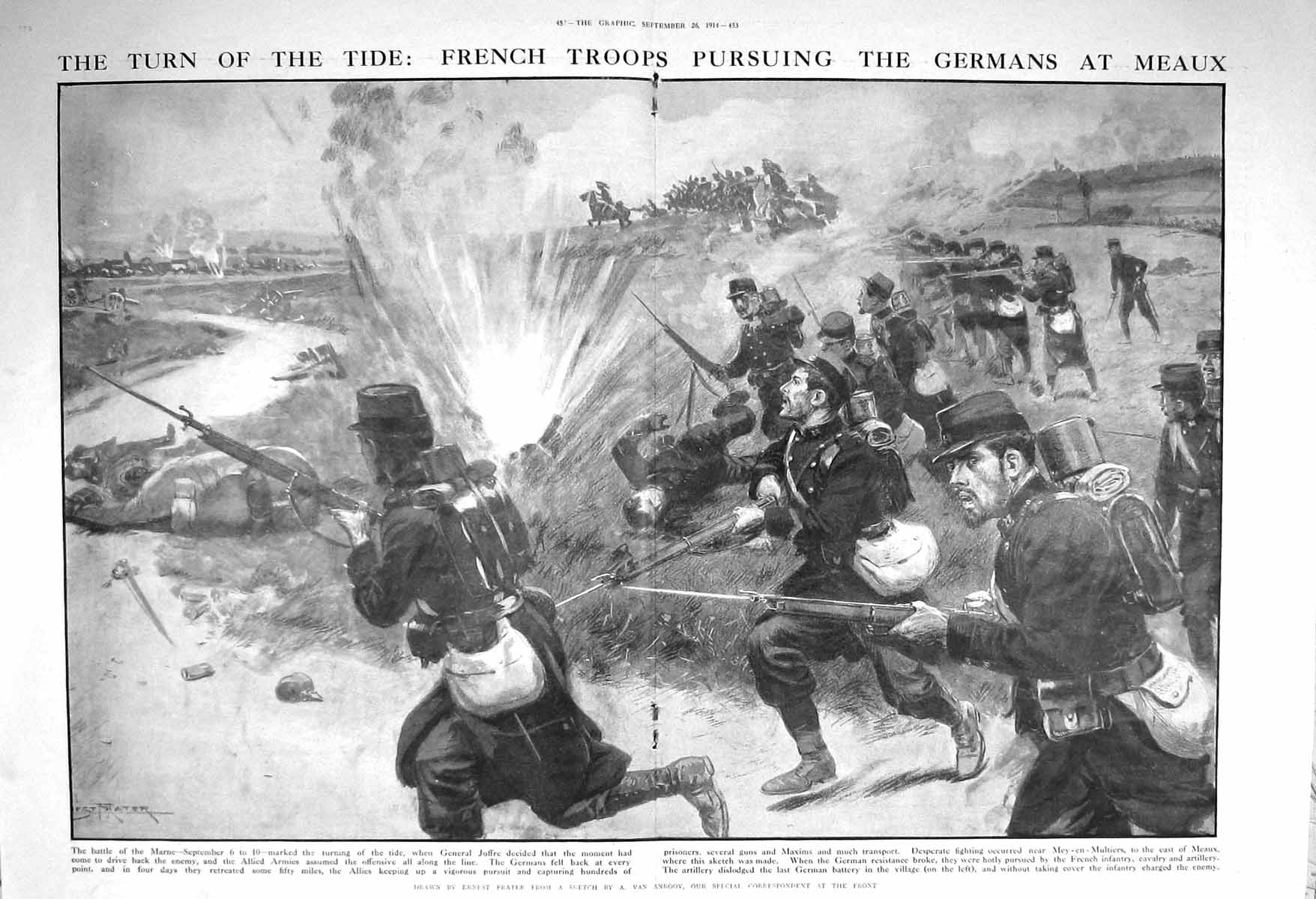
The Marne Stops Germany’s Rush on Paris
French and British troops halted the German advance east of Paris and ended hopes of a quick war.
At dawn on 6 September 1914, French and British troops launched a massive counter-offensive along a front of roughly 100 miles (160 kilometres) east of Paris. The clash ended the Great Retreat, during which the German armies had swept through Belgium and northern France following their victories in August. Germany entered the war hoping to defeat France quickly, allowing its forces to turn east toward Russia. Instead, as German divisions pressed south toward Paris, their rapid march had outrun supply lines and exhausted the troops.
German Chief of General Staff Helmuth von Moltke had earlier altered his war plan, abandoning a wide envelopment west of Paris in favor of bypassing the capital to the north and trapping the French armies from behind. Alexander von Kluck, commander of the German 1st Army, pushed his men across the Marne River southeast of Paris on 3 September. That movement left his right flank exposed. General Joseph Gallieni, the military governor of Paris, recognized the vulnerability and directed the newly formed French 6th Army under Michel-Joseph Maunoury to prepare a flank attack.

Keep reading in Yester
Coming soonKeep following the story
Sources
- The First Battle of the Marne (History.com)
- A Fleet of Taxis Did Not Really Save Paris From the Germans (Smithsonian Magazine)
- First Battle of the Marne: How Paris was Saved in World War I (World History Encyclopedia)
- Conflict, Chaos, and Auftragstaktik (Army University Press, Military Review)
- First Battle of the Marne
Image: Ernest Prater · Public domain · Wikimedia Commons · cropped
