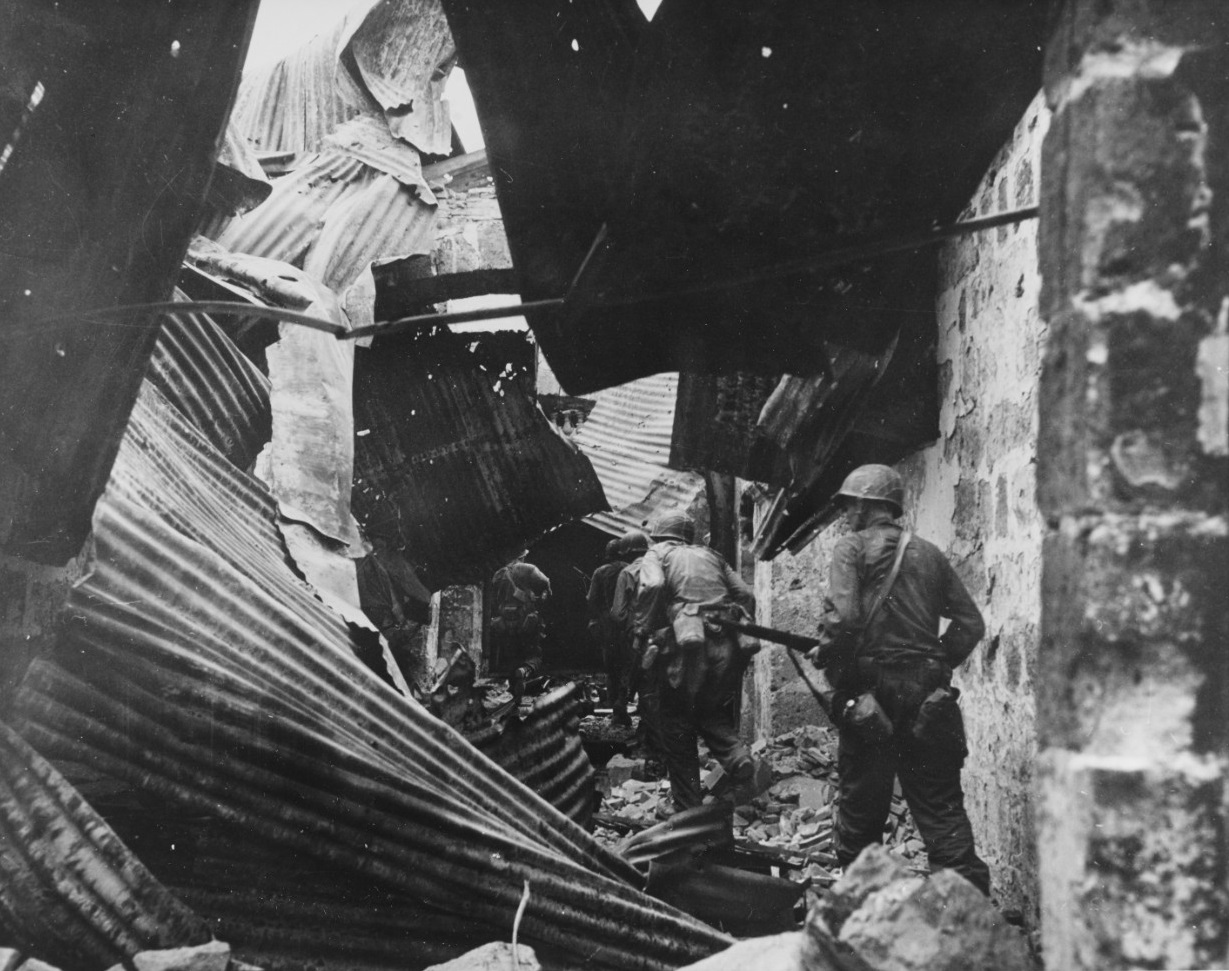
A Month of Street Fighting Destroys Manila
American and Filipino troops fought Japanese forces through the city, and commonly cited estimates put civilian deaths at about 100,000 as old Manila was destroyed.
On February 3, 1945, advance elements of the United States Army pushed into the northern outskirts of Manila to liberate the Philippine capital from Japanese occupation. Allied forces, including American soldiers and Filipino guerrillas, made initial rapid gains across northern neighborhoods, capturing Malacañang Palace and liberating thousands of internees at the University of Santo Tomas and Bilibid Prison. Although General Douglas MacArthur announced on February 6 that Manila had fallen, organized resistance had only begun to stiffen across the Pasig River.
The defense of the city revealed a significant division within the Japanese command. General Tomoyuki Yamashita, the supreme Japanese army commander in the Philippines, intended to withdraw his forces to the mountainous regions of northern Luzon to conduct a campaign of attrition. Yamashita considered the city indefensible, declared it an open city and ordered Iwabuchi to evacuate. However, Rear Admiral Sanji Iwabuchi, commander of the Manila Naval Defense Force, refused to leave and organized approximately seventeen thousand naval personnel and army troops into fortified enclaves throughout the capital.

Keep reading in Yester
Coming soonKeep following the story
Sources
- Did 100,000 civilians die in the Battle of Manila in 1945? (Meixsel, corregidor.org)
- Did you know: Intramuros residents held hostage during WWII (Philippine Daily Inquirer)
- Manila's utter destruction during World War II (Inquirer)
- The Battle of Manila: Destroying the Pearl (Warfare History Network)
- The WWII Battle of Manila (Military.com)
- Battle of Manila (1945)
Image: National Archives 80-G-273411 · Public domain · Wikimedia Commons · cropped
