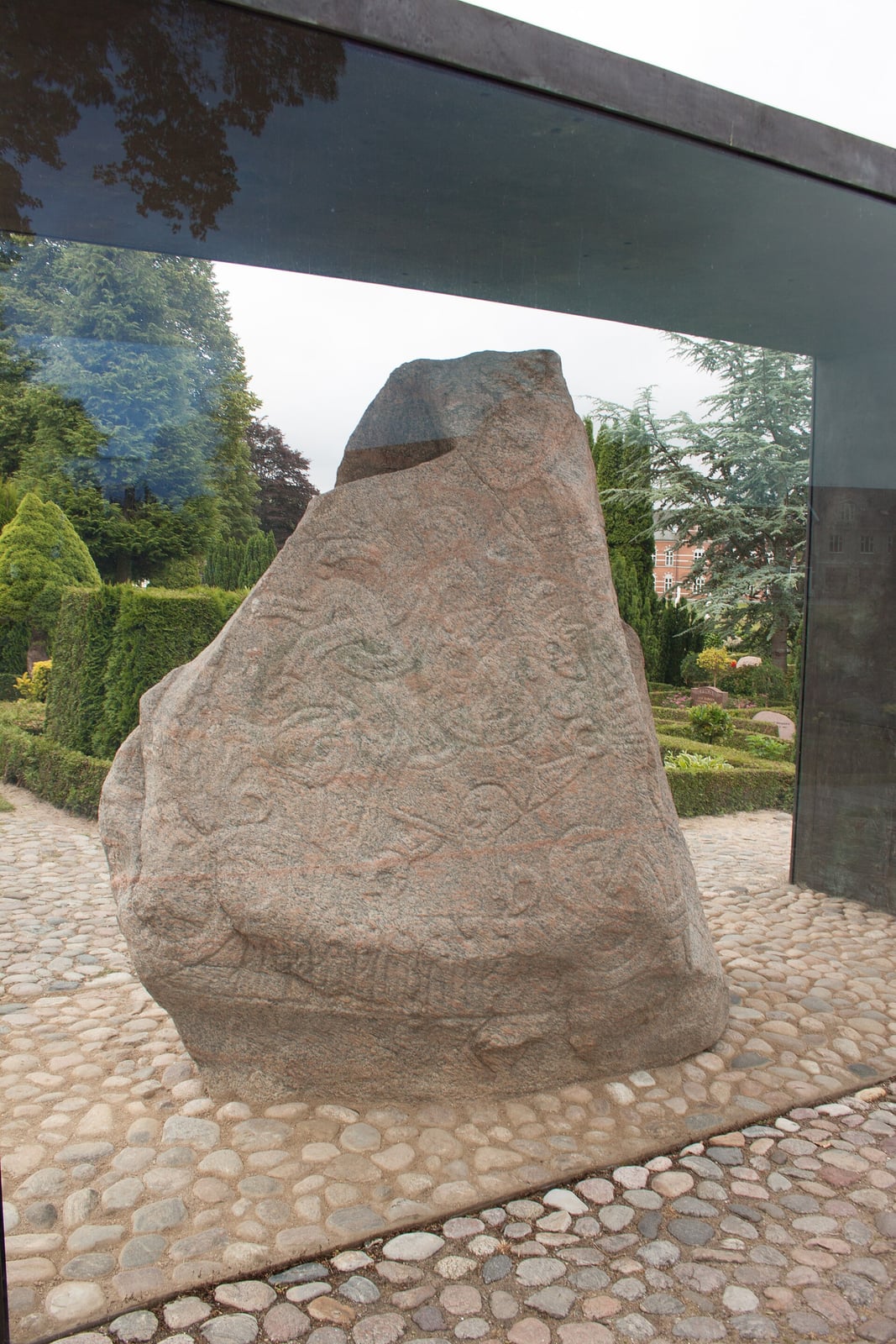
Harald Bluetooth Raises a Runestone at Jelling
King Harald carved a great runestone boasting that he had won all of Denmark and Norway and made the Danes Christian.
During the tenth century, the Scandinavian royal settlement at Jelling in Jutland became the setting for two monumental stone carvings that marked a transformative era in northern European statecraft. The older and smaller of these monuments had been commissioned by King Gorm the Old in memory of his wife Thyra. Around 965, according to the National Museum of Denmark, Gorm's son, King Harald Bluetooth, ordered the erection of a second, significantly larger runestone at the site. The monument honoured Harald's deceased parents while proclaiming his own political triumphs, specifically asserting his mastery over both Denmark and Norway alongside his conversion of the Danish people to the Christian faith.
The texts carved across both monuments are among the most celebrated runic inscriptions in Denmark, in part because they contain the earliest surviving domestic references to the realm by name. On Gorm's earlier monument, the territory appears in the grammatical genitive form as tanmarkar, whereas Harald's stone records the accusative tanmaurk. Harald's inscription combines political conquest and religious change, stating that he won all of Denmark and Norway and made the Danes Christian. Because of this proclamation of the Danes' conversion, the art historian Rudolf Broby-Johansen coined the popular twentieth-century description of Harald's stone as Denmark's baptism certificate.

Keep reading in Yester
Coming soonKeep following the story
Sources
- The Jelling Stone (National Museum of Denmark)
- A nation's birth certificate (Weekly Word, EU)
- Harald Blåtands runesten i Jelling. Epigrafi, kronologi og historie (Kuml, tidsskrift.dk)
- Covering of the Runic Stones in Jelling by NOBEL Arkitekter (Dezeen)
- The Jelling monuments (UNESCO World Heritage)
- Jelling stones (Qualla)
- Jelling stones
Image: Szilas · CC0 · Wikimedia Commons · cropped
