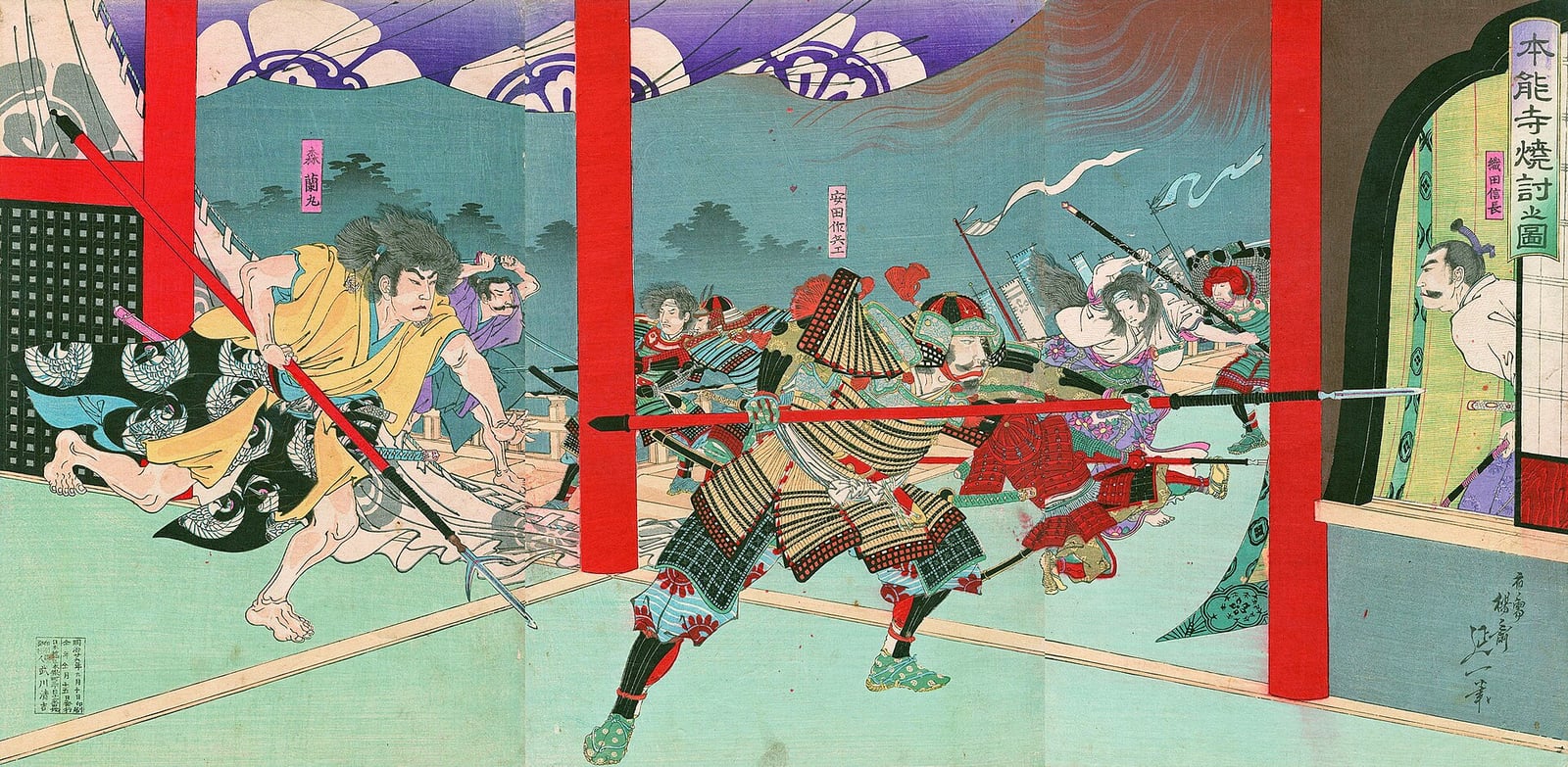
Akechi Mitsuhide Turns on Oda Nobunaga at Honnō-ji
Nobunaga’s own general surrounded the Kyoto temple where he was staying, and the warlord who had brought much of Japan under his control died there.
In June 1582, Oda Nobunaga had established military dominance across central Japan and stood on the brink of unifying the country under his rule. After destroying the rival Takeda clan earlier that year, Nobunaga dispatched his senior commanders across several fronts to subdue remaining opponents, including the Uesugi and the beleaguered Mori clan. While preparing to personally reinforce his general Hashiba Hideyoshi in western Japan, Nobunaga paused in Kyoto. He chose to lodge at Honno-ji, a Kyoto temple, which he used as a base during his visits to the capital.
Nobunaga traveled with minimal protection, relying on a small escort of retainers, pages, and servants, commonly put at around a hundred or a little more, while his vast field armies fought elsewhere. Taking advantage of this vulnerability, one of his senior regional commanders, Akechi Mitsuhide, turned against him. Ordered to march west with an army usually put at about 13,000 soldiers to support Hideyoshi, Mitsuhide abruptly changed course toward Kyoto before dawn. Later accounts say that Mitsuhide concealed his objective from most of his subordinates until the last moment. Historians still debate his motive.

Keep reading in Yester
Coming soonKeep following the story
Sources
- Oda Nobunaga (World History Encyclopedia)
- Azuchi-Momoyama Period (World History Encyclopedia)
- Toyotomi Hideyoshi (World History Encyclopedia)
- The Three Unifiers of Sengoku Era Japan (Japan Society)
- The Honno-ji Incident (Samurai Bushido)
- Battle of Yamazaki (Sengoku Kassenroku)
- The Honno-ji Incident and the Death of Nobunaga (Samurai History and Culture)
- Honnō-ji Incident
Image: Nobukazu Yōsai · Public domain · Wikimedia Commons · cropped
