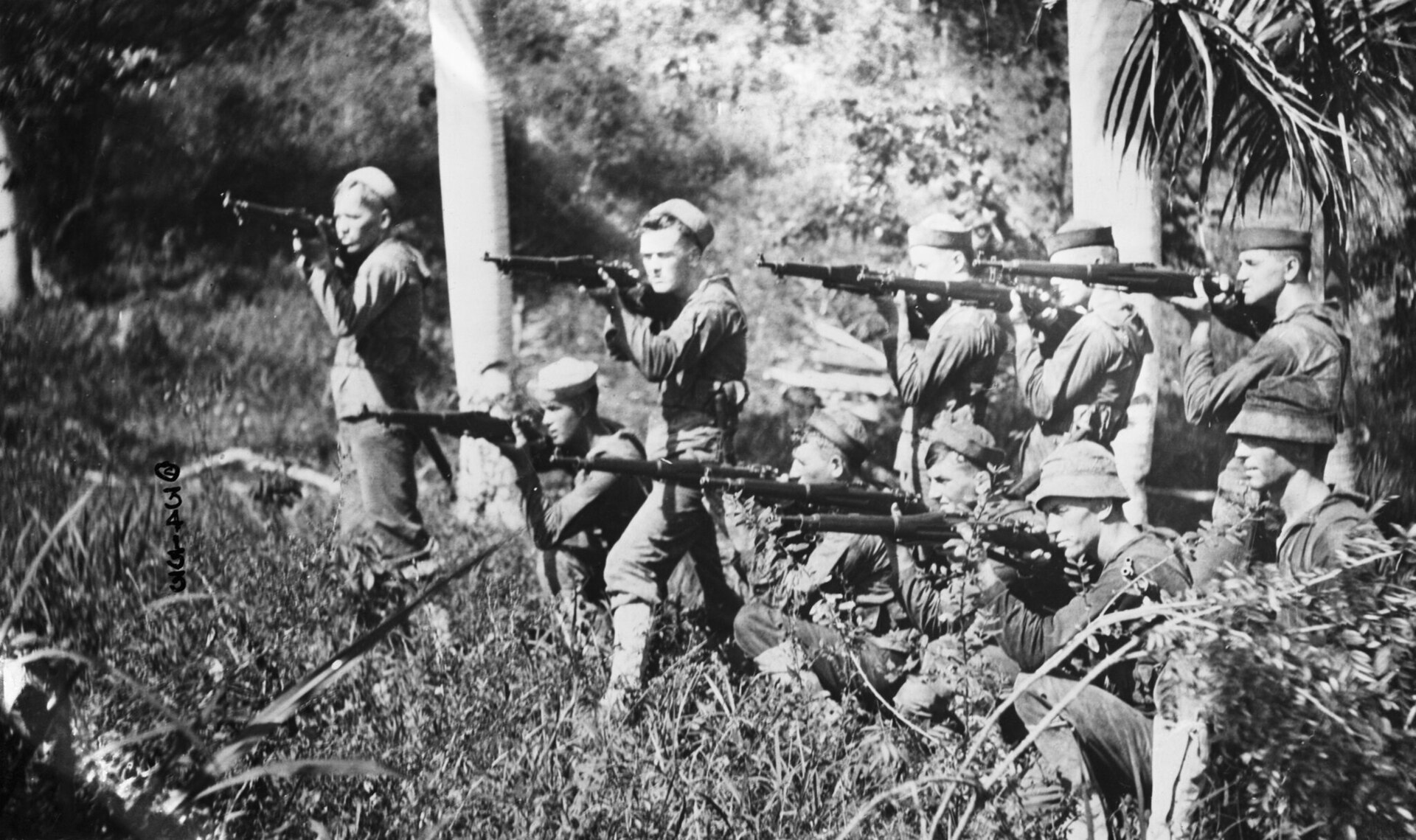
American Marines Land in Haiti and Stay Nineteen Years
After a Haitian president was killed by a crowd, US Marines landed in Port-au-Prince and began an occupation that lasted until 1934.
On July 28, 1915, about 330 American Marines and sailors disembarked at Port-au-Prince under the command of Rear Admiral William Banks Caperton. The intervention followed hours after a crowd killed Haitian President Vilbrun Guillaume Sam, who had sought refuge in the French legation after reportedly ordering the execution of roughly 170 political prisoners. While President Woodrow Wilson publicly presented the landing as an operation to restore stability, American authorities moved rapidly to secure administrative authority. Resistance was slight, and the Marines took control of the capital within hours.
The deployment culminated years of expanding American financial and strategic designs in the Caribbean. American investors held a stake in the Haitian national bank, and Washington sought to protect the customs revenue that serviced Haiti's debts. Months before the landing, in December 1914, American Marines had removed roughly five hundred thousand dollars in gold reserves from the national bank in Port-au-Prince and shipped it to the bank's vaults in New York. Rising wartime anxieties in Washington over German commercial influence near the Panama Canal Zone further pushed Washington toward intervention.

Keep reading in Yester
Coming soonKeep following the story
Sources
- Milestones: Haiti, 1915 (US Office of the Historian)
- The U.S. Occupation of Haiti, 1915-1934 (Congressional Research Service report 94-459)
- Ragtime Diplomacy (American Heritage)
- Foreign Relations of the United States 1914, Haiti dispatches on the gold removal (Office of the Historian)
- United States occupation of Haiti
Image: Unknown author · Public domain · Wikimedia Commons · cropped
