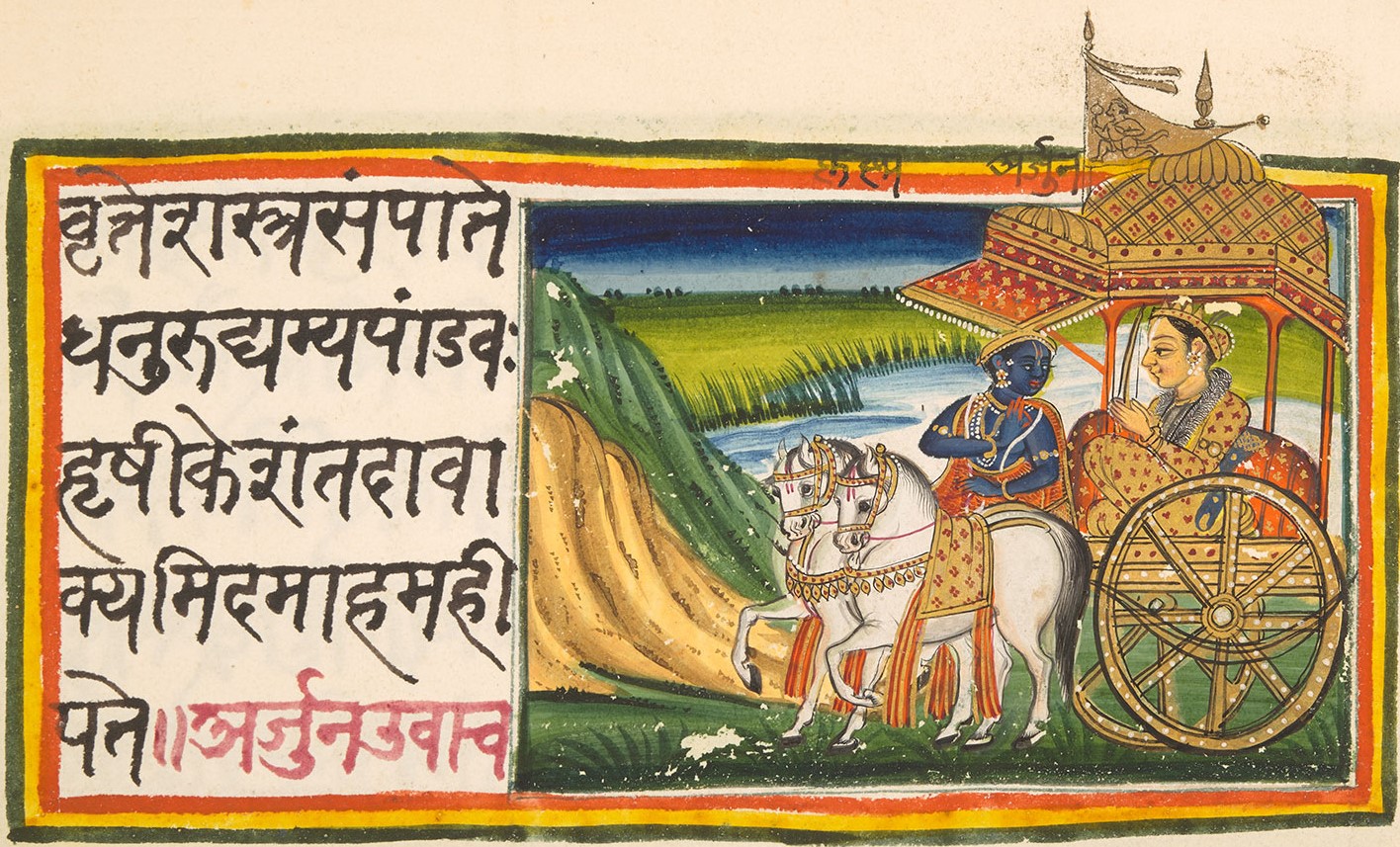
The Bhagavad Gita Sets Duty on a Battlefield
A dialogue between a warrior prince and Krishna became one of the most read and debated texts in Hinduism.
Embedded within the Bhishma Parva of the expansive Indian epic Mahabharata, the Bhagavad Gita unfolds as an eighteen-chapter dialogue on the brink of battle at Kurukshetra. Two large armies stand poised for conflict, yet the Pandava prince Arjuna hesitates upon seeing relatives, teachers, and companions among the opposing ranks. Overcome by grief and moral uncertainty, he sets aside his weapons and questions whether he should abandon his role as a warrior. Arjuna turns for guidance to his charioteer Krishna, an avatar of Vishnu, whose extensive counsel transforms a battlefield crisis into a wide-ranging examination of ethical action and spiritual duty.
The dating and composition of the poem remain subjects of enduring scholarly debate. While religious tradition credits the sage Vyasa with the entire epic, modern historians view the work as a composite creation by multiple authors, possibly shaped over several centuries. Estimates for its composition range from as early as the fifth century BCE to the early centuries CE, and while some scholars place it around the second century BCE, others, such as the historian of religions Wendy Doniger, suggest the first or second century CE. Linguistically, the Sanskrit verse features archaic elements that place its emergence between Vedic usage and the heavily compounded structures of later classical Sanskrit literature.

Keep reading in Yester
Coming soonKeep following the story
Sources
Image: Unknown artist · Public domain · Wikimedia Commons · cropped
