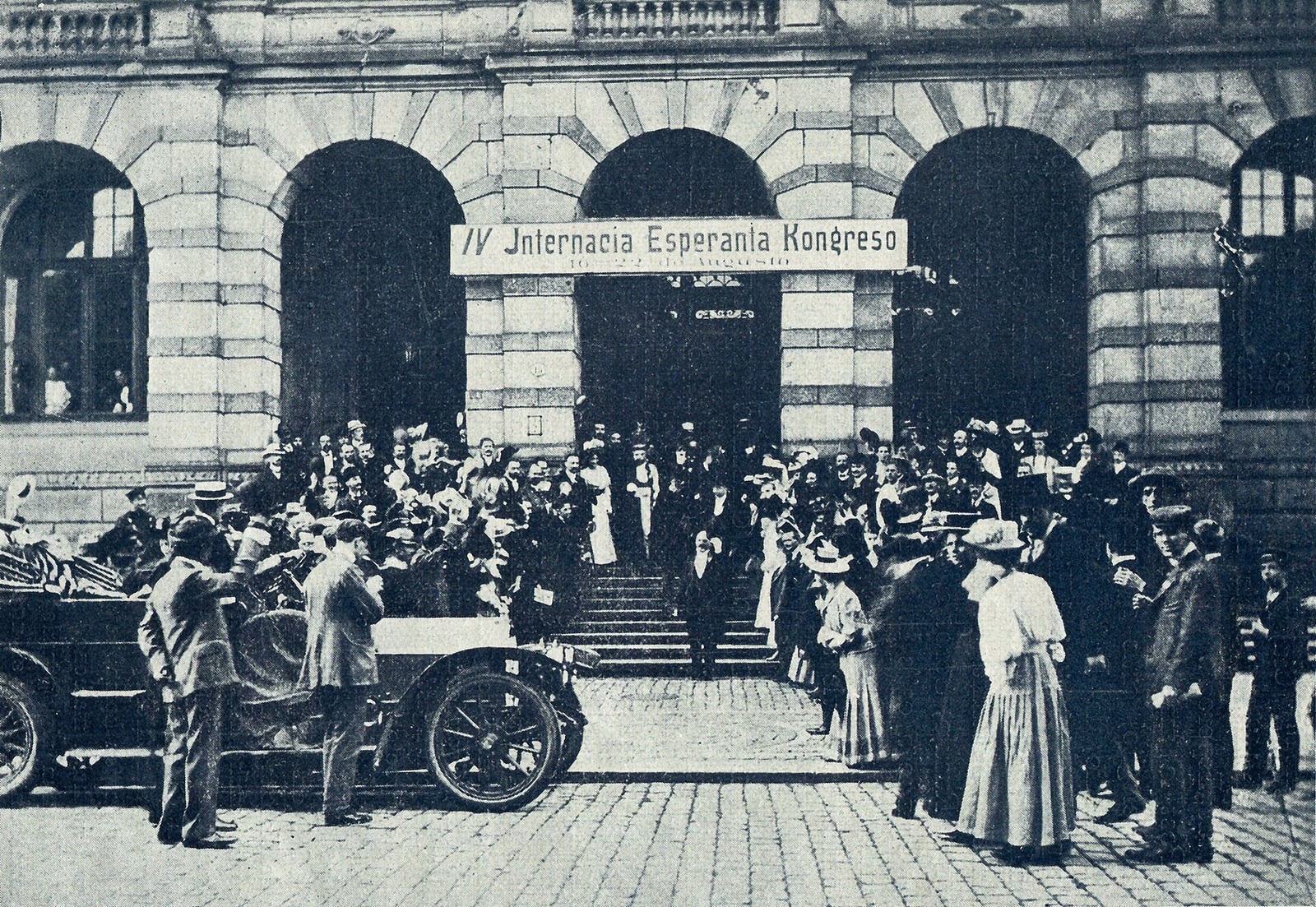
Zamenhof Publishes Esperanto, a Language for Everyone
An eye doctor in Russian Poland offered a simple second language to bridge peoples divided by speech.
On 26 July 1887, an eye doctor named L. L. Zamenhof self-published a modest Russian-language booklet in Warsaw introducing what he called la Internacia Lingvo, or the International Language. Writing under the pseudonym Doktoro Esperanto, meaning one who hopes, Zamenhof presented a newly engineered auxiliary speech intended to serve as a universal second tongue. Having grown up in the multilingual city of Białystok, where communities divided along Russian, Polish, German, and Jewish lines viewed one another with deep suspicion, he believed linguistic fragmentation formed a fundamental barrier to human fellowship. Early readers soon adopted his pseudonym as the proper name for the project itself.
The publication of the booklet, later remembered as Unua Libro, introduced a system built for rapid learning and practical communication. Rather than inventing an entirely arbitrary vocabulary, Zamenhof drew most of his word roots from Romance tongues, alongside elements from Germanic, Slavic, and Greek sources. The core lexicon comprised only about nine hundred base roots, but these could be multiplied into thousands of precise concepts through a regular framework of prefixes, suffixes, and compounds. Words were spelled phonetically using a modified Latin alphabet, and the grammatical rules were designed without the irregular exceptions found in natural European tongues.

Keep reading in Yester
Coming soonKeep following the story
Sources
Image: Unknown author · Public domain · Wikimedia Commons · cropped
