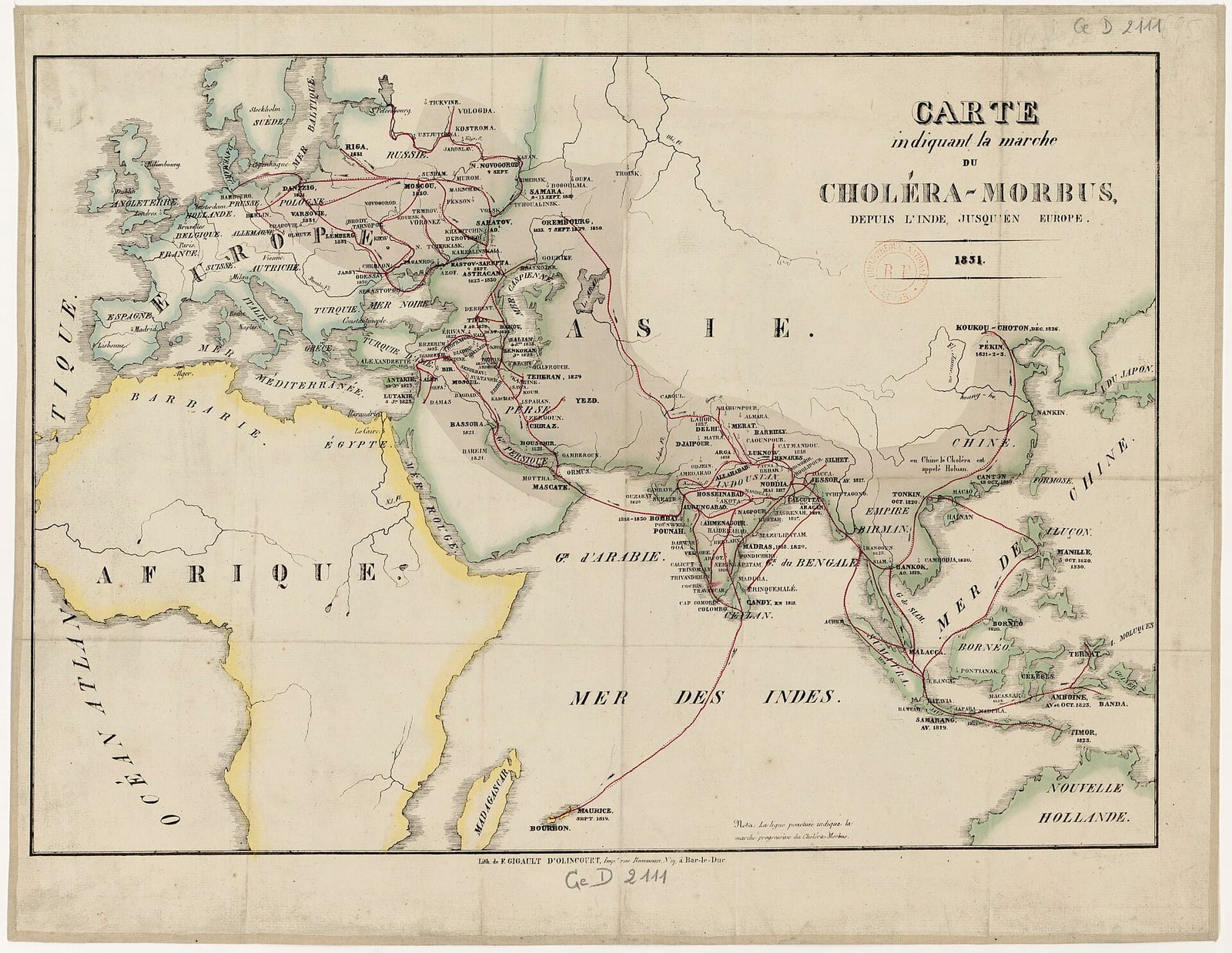
Cholera Breaks Out of Bengal and Becomes a World Disease
An outbreak near Calcutta spread along trade and army routes to China, Arabia and the edge of Europe.
In August 1817, an outbreak of severe diarrheal illness surfaced in the town of Jessore in the Ganges Delta. The lower Ganges region had long experienced cholera, and Indian records described similar outbreaks for centuries before 1817. Earlier outbreaks had frequently emerged among travelers during religious festivals, only to subside within the region. In 1817, however, the affliction escaped its traditional boundaries. By September of that year, it had entered Calcutta on the Bay of Bengal, rapidly crossing the subcontinent and establishing itself on the western coast in Bombay by 1818.
The contagion soon followed commercial and military pathways across the globe. Advances in maritime navigation and imperial troop movements accelerated its transmission. In 1820, cases appeared across Southeast Asia, striking Siam, Bangkok, Manila, and Vietnam. By 1821, maritime and trade routes carried the infection to Java and to Anhai in China. Troops sent from Bombay to Oman were blamed for bringing it to Arabia, and it reached Muscat in July 1821. Ships carried it across the Indian Ocean to Mauritius as early as 1819, while overland routes through Persia brought it to the port of Astrakhan on the Caspian Sea in September 1823.

Keep reading in Yester
Coming soonKeep following the story
Sources
- An Account of the Rise and Progress of the Indian or Spasmodic Cholera, New Haven 1832 (US National Library of Medicine Digital Collections)
- A History of Asiatic Cholera, C. Macnamara, 1876 (Internet Archive)
- Gazetteer of the Persian Gulf, Vol I, J. G. Lorimer, 1915 (Qatar Digital Library)
- 1817–1824 cholera pandemic
Image: Unknown author · Public domain · Wikimedia Commons · cropped
