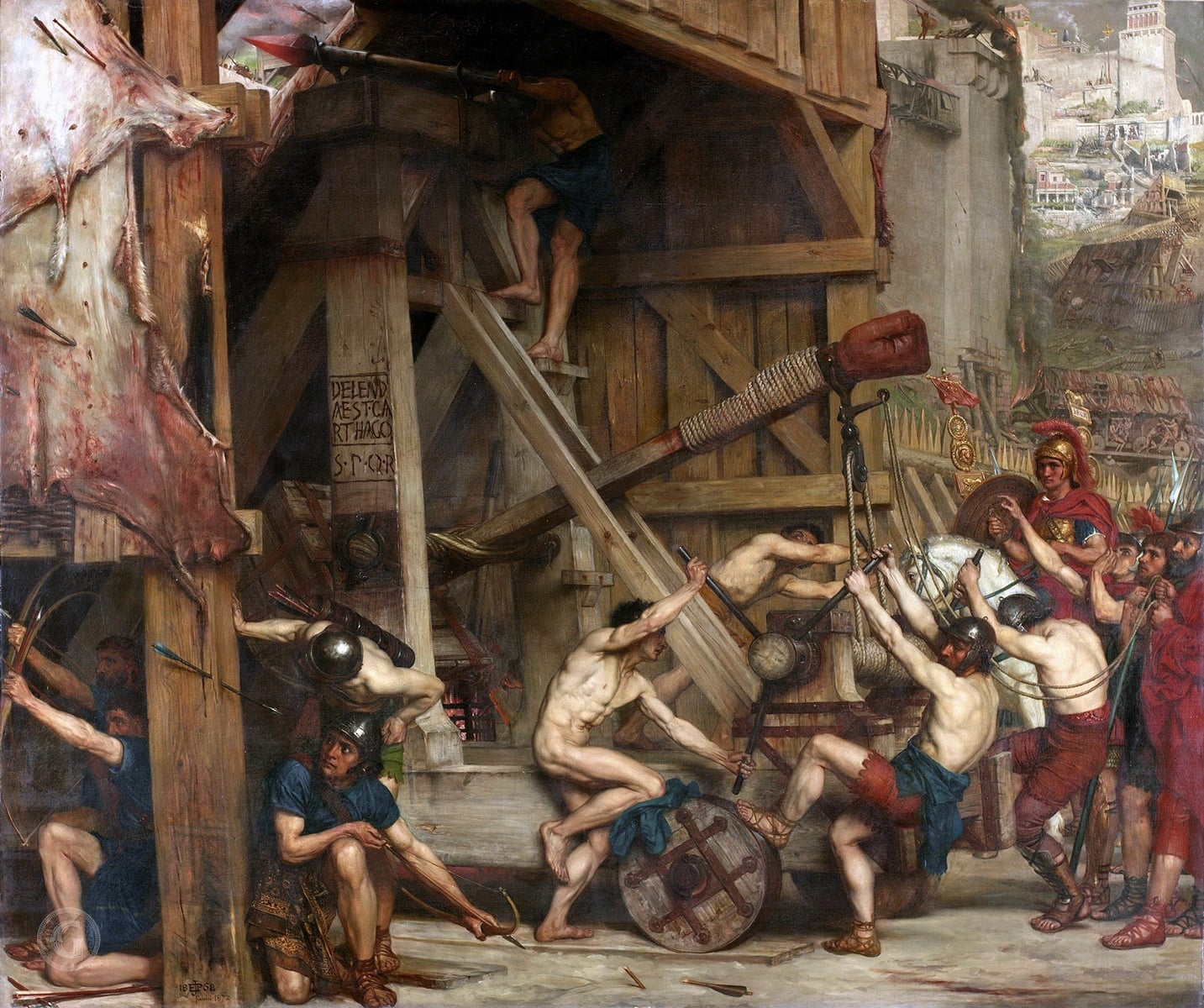
Rome Destroys Carthage
After a three-year siege, Roman troops stormed Carthage, sold its survivors into slavery and turned its lands into the province of Africa.
In 149 BC, a large Roman expedition landed at Utica in North Africa, opening the Third Punic War against Carthage. Decades earlier, the peace treaty ending the Second Punic War had placed severe limits on the Carthaginian state, which was forbidden from conducting military campaigns outside Africa, or within Africa without Roman consent. Over the following fifty years, Rome repeatedly refused to intervene when its ally, the Numidian king Masinissa, raided and annexed Carthaginian territories. Carthage finally raised an army under the general Hasdrubal in 150 BC to repel these incursions, but the force suffered a catastrophic defeat at the Battle of Oroscopa. A hostile faction within the Roman Senate seized on this unpermitted military campaign as a formal justification to organize an armed invasion.
Hoping to avert hostilities, the Carthaginian authorities sent envoys to Utica and initially agreed to surrender their arsenals. According to the ancient historian Appian, the Romans received two thousand catapults and two hundred thousand suits of armor, alongside Carthage's warships, which were burned in the port. Once the city had been disarmed, however, Roman magistrates presented an unacceptable final demand that the inhabitants raze Carthage and move at least sixteen kilometers inland from the Mediterranean coast. Faced with displacement, the citizens resolved to defend their heavily fortified metropolis. They freed enslaved people willing to take up arms, manufactured new equipment, and recalled a general also named Hasdrubal from exile to lead a field army outside the walls, while another Hasdrubal, known as the Boetharch, commanded the city.

Keep reading in Yester
Coming soonKeep following the story
Sources
Image: Edward Poynter · Public domain · Wikimedia Commons · cropped
