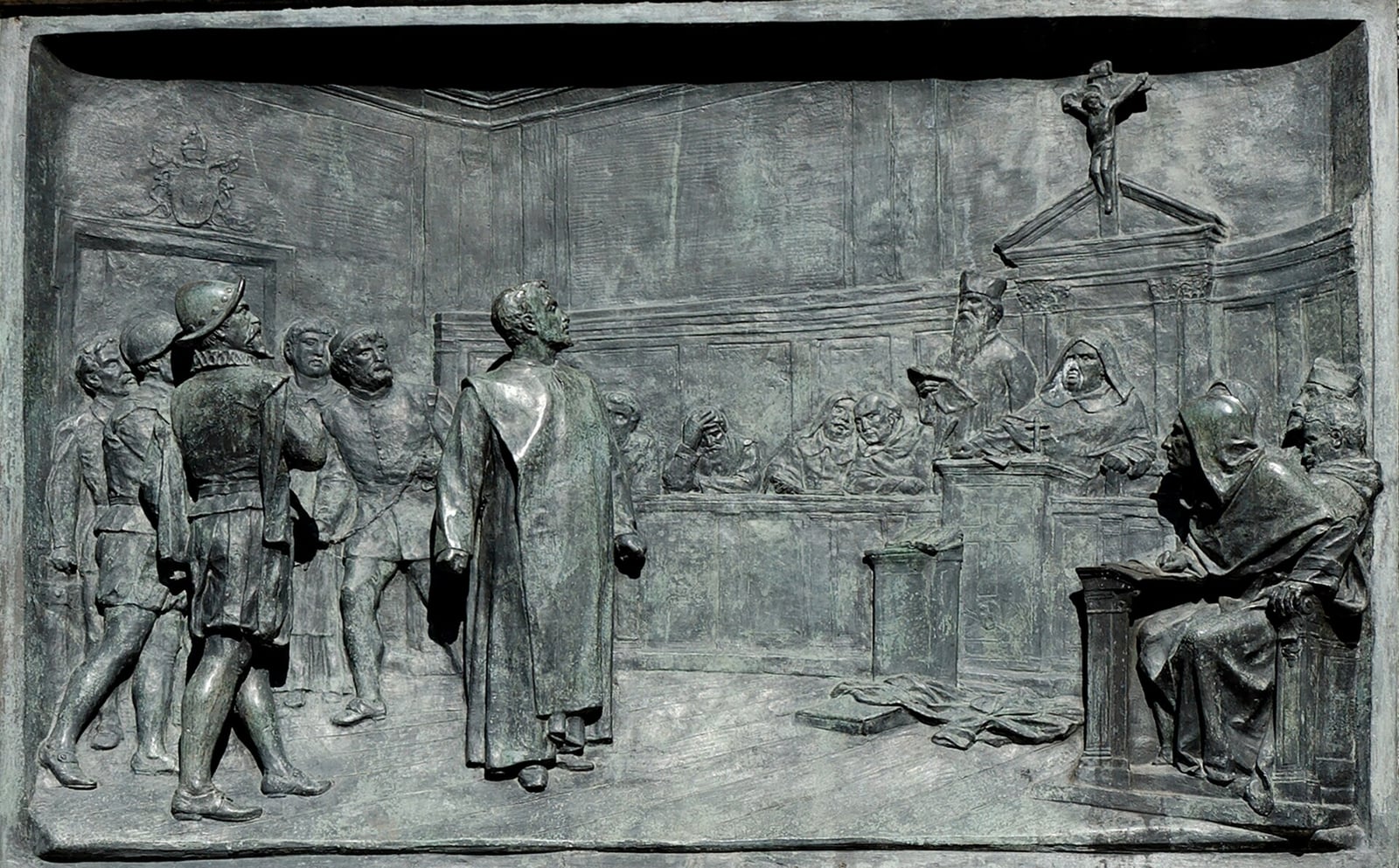
Giordano Bruno Is Burned for Heresy in Rome
A friar who imagined an infinite universe of many worlds refused to recant and was executed in the Campo de’ Fiori.
On February 17, 1600, the philosopher and former Dominican friar Giordano Bruno was led into Rome's Campo de' Fiori, stripped, and burned alive at the stake. Secular officials carried out the execution following a decree from the Roman Inquisition and Pope Clement VIII, who declared Bruno an unrepentant heretic. A metal gag was clamped over his tongue, apparently so that he could not address the gathered crowd. The execution silenced a thinker who had spent more than fifteen years unsettling Catholic, Protestant, and academic orthodoxies across Europe.
Born Filippo Bruno in Nola near Naples in 1548, he joined the Dominican Order at seventeen and received ordination as a Catholic priest in 1572. His exceptional memory earned him early recognition; by his own later account, he was invited to Rome to display it before Pope Pius V. However, his private reading and theological departures quickly drew suspicion. Inquisitorial proceedings opened against him in Naples over his possession of banned writings by Erasmus and his alleged defense of the Arian heresy. Fleeing the convent in 1576 to escape an impending indictment, Bruno abandoned his religious habit and embarked on a prolonged journey through Northern Italy, France, England, and the German principalities.

Keep reading in Yester
Coming soonKeep following the story
Sources
Image: Jastrow · Public domain · Wikimedia Commons · cropped
