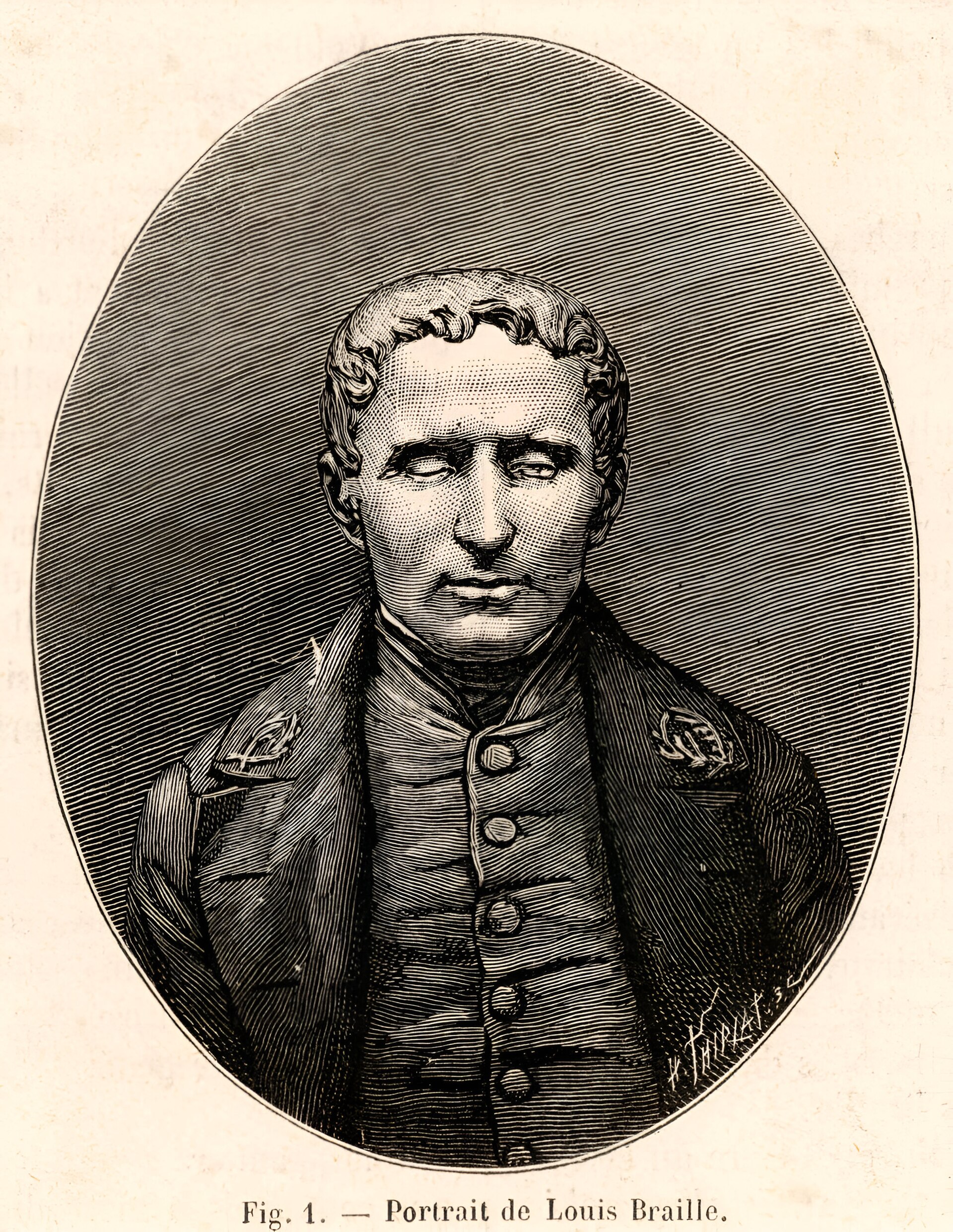
Louis Braille Publishes a Raised-Dot Alphabet for Blind Readers
A blind student’s system of six-dot cells let readers feel letters with a fingertip and is used around the world.
In 1829, Louis Braille published an embossed writing method that provided blind individuals with a structured tactile medium for reading and writing. Braille had lost his sight following an accident during his childhood. At fifteen years old in 1824, while a student in Paris, he developed an alternative communication system by modifying an earlier tactile method created by Charles Barbier. The 1829 publication formalized this work, establishing a tactile alphabet alongside a system for transcribing musical notation.
Barbier had originally formulated a tactile code, known as night writing, that used embossed patterns of up to twelve dots, arranged in two columns of six, to represent the sounds of French. Braille recognized critical practical shortcomings in Barbier's design. The phonetic foundation prevented readers from learning conventional written spelling and orthography, and the code omitted symbols for numerals and punctuation marks. Furthermore, the twelve-dot matrices were too expansive to fit comfortably beneath the pad of a single finger, requiring readers to shift their fingers across each symbol and slowing comprehension.

Keep reading in Yester
Coming soonKeep following the story

Sources
Image: Henri Thiriat · Public domain · Wikimedia Commons · cropped
