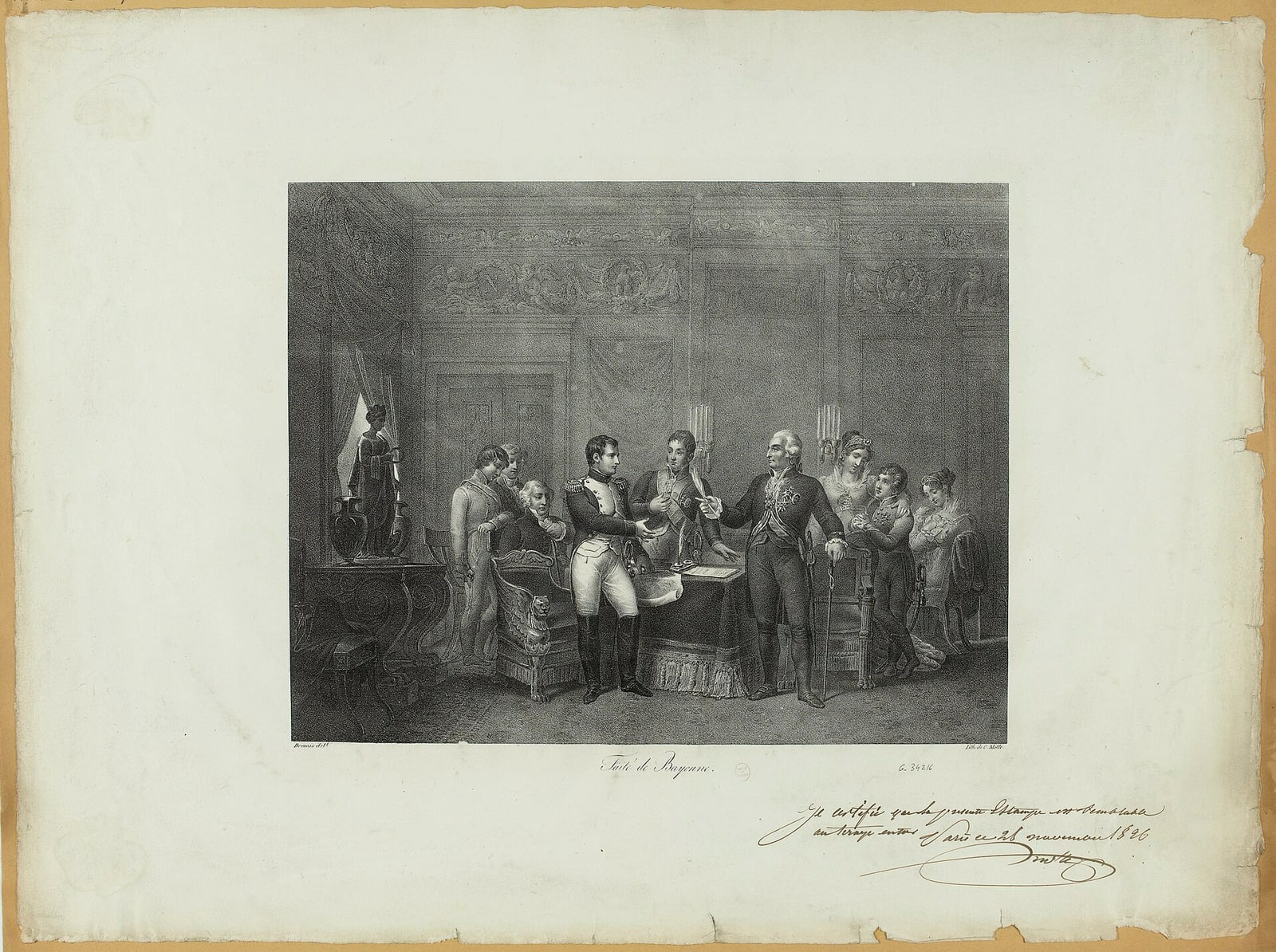
Napoleon Takes the Spanish Crown at Bayonne
Napoleon pressed Spain’s kings to give up the throne to his brother, and across Spanish America people asked who now ruled.
In May 1808, Napoleon gathered the Spanish royal dynasty across the French border at Bayonne to resolve a bitter family dispute and settle the succession of Spain. Two months earlier, the Tumult of Aranjuez had deposed Manuel Godoy, the chief minister of King Charles IV, and compelled the aging monarch to abdicate in favor of his son, Ferdinand VII. Seeking imperial recognition to secure his precarious new authority, Ferdinand traveled north into southwestern France, unaware that Napoleon had already concluded that the Bourbon dynasty was too unstable to remain allied with his empire.
Ferdinand arrived in Bayonne on April 20 and was accommodated at the local intendancy building, where he quickly learned that Napoleon refused to address him as king. Ten days later, Charles IV and Queen Maria Luisa reached the city, greeted with royal honors and installed at the Government Palace. Joined by the released Godoy, Charles insisted that his initial surrender of power had been extracted under duress during an armed rebellion. Exploiting the mutual hatred dividing father and son, Napoleon orchestrated a confrontation between them, demanding that Ferdinand relinquish the crown back to Charles.

Keep reading in Yester
Coming soonKeep following the story

Sources
- Ferdinand VII (Encyclopaedia Britannica)
- Napoleonic Timeline of 1808 (napoleon-empire.org)
- Ferdinand VII (napoleon-empire.org)
- 1808: L'affaire espagnole jusqu'au Dos de Mayo (Fondation Napoleon)
- Abdicaciones de Bayona y estallido de la Guerra de la Independencia (Universidad Carlos III de Madrid OCW)
- Jose I Napoleon (Archontology)
- S. M. Coronas, article in Historia Constitucional
- Abdications of Bayonne
Image: Molte, C., dessinateur-lithographe · CC0 · Wikimedia Commons · cropped
