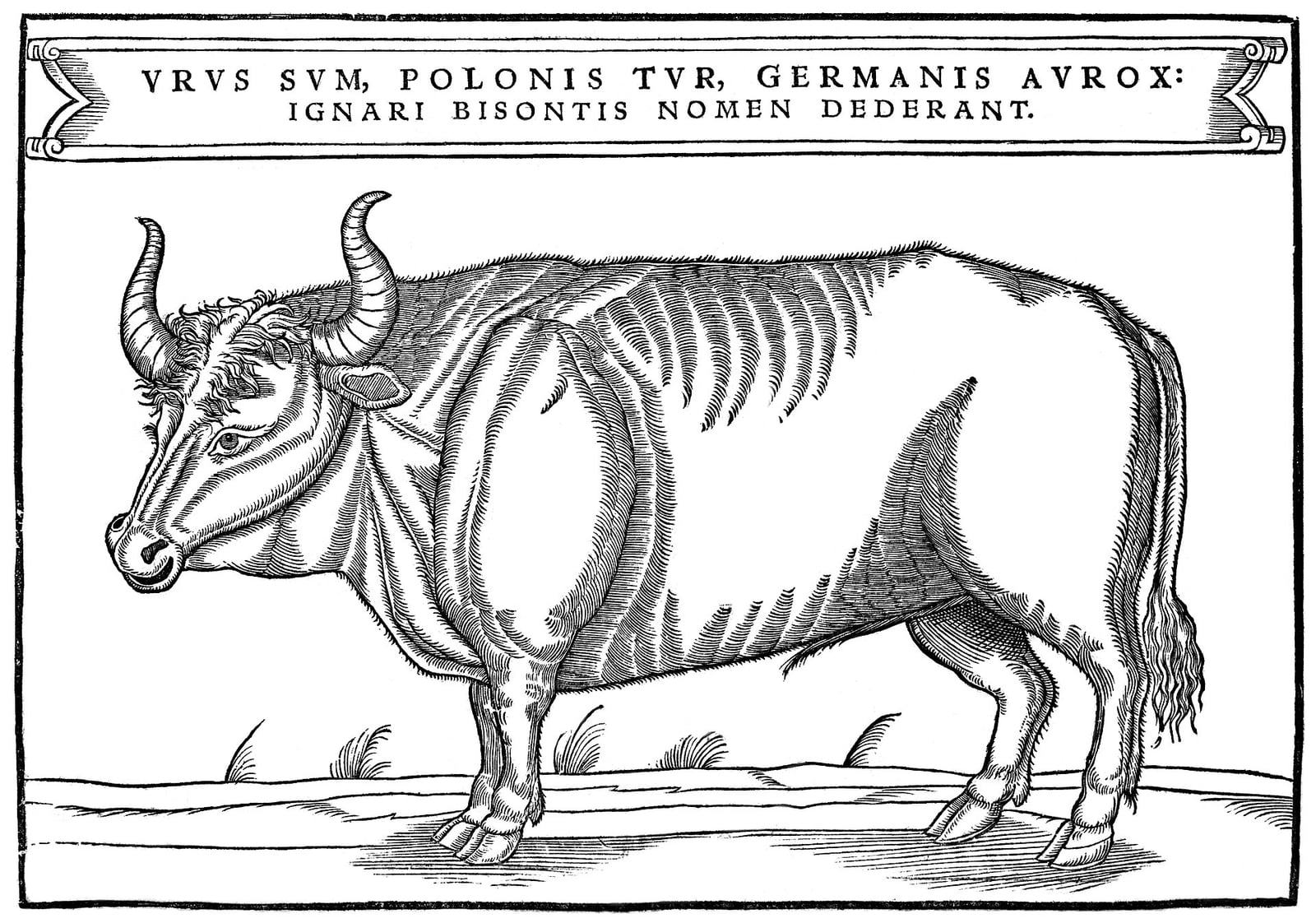
The Last Aurochs Dies in a Polish Royal Forest
Europe’s great wild ox, painted at Lascaux and ancestor of cattle, became one of the first extinctions anyone recorded.
In 1627, the last confirmed aurochs, a wild cow, died in the marshy woodland of Jaktorów Forest, southwest of Warsaw, of natural causes according to a royal inspection report of 1630. This death brought an end to an animal that had once roamed across North Africa, the Middle East, Asia, and Europe. Unlike many prehistoric mammals that vanished with little notice from chroniclers, the final population in Poland had been formally counted and protected by royal decree for generations. The decline from a few dozen animals in the mid-sixteenth century to just four in the early 1600s revealed that even direct intervention by the Polish Crown could not halt the slow collapse of an isolated remnant.
The aurochs had long stood as one of the largest herbivores of the Holocene epoch. Mature bulls reached up to 1.8 metres in shoulder height, possessed large forward-curving horns that could reach 80 centimetres or more in length, and developed athletic forequarters with pronounced neck and shoulder musculature. Sixteenth-century accounts, such as those published by Sigismund von Herberstein, described the aurochs as pitch-black with a pale stripe along the spine, while modern reconstructions suggest that cows had a reddish-brown coat. Their massive physical presence and formidable strength made adult animals relatively secure from natural predators, leaving them feared and admired by human cultures for millennia.

Keep reading in Yester
Coming soonKeep following the story
Sources
- History of the Aurochs (Bos taurus primigenius) in Poland (Animal Genetic Resources, Cambridge University Press)
- Aurochs (Artensterben)
- Aurochs (Climate and Loss, Harvard University)
- DNA traces cattle back to a small herd domesticated around 10,500 years ago (ScienceDaily, from UCL)
- Disappearance beyond recall: a social context for Bronze Age aurochs extinction in Britain (Proceedings of the Prehistoric Society, Cambridge University Press)
- Bos primigenius primigenius (Recently Extinct Species)
- Aurochs
Image: Siegmund von Herberstein · Public domain · Wikimedia Commons · cropped
