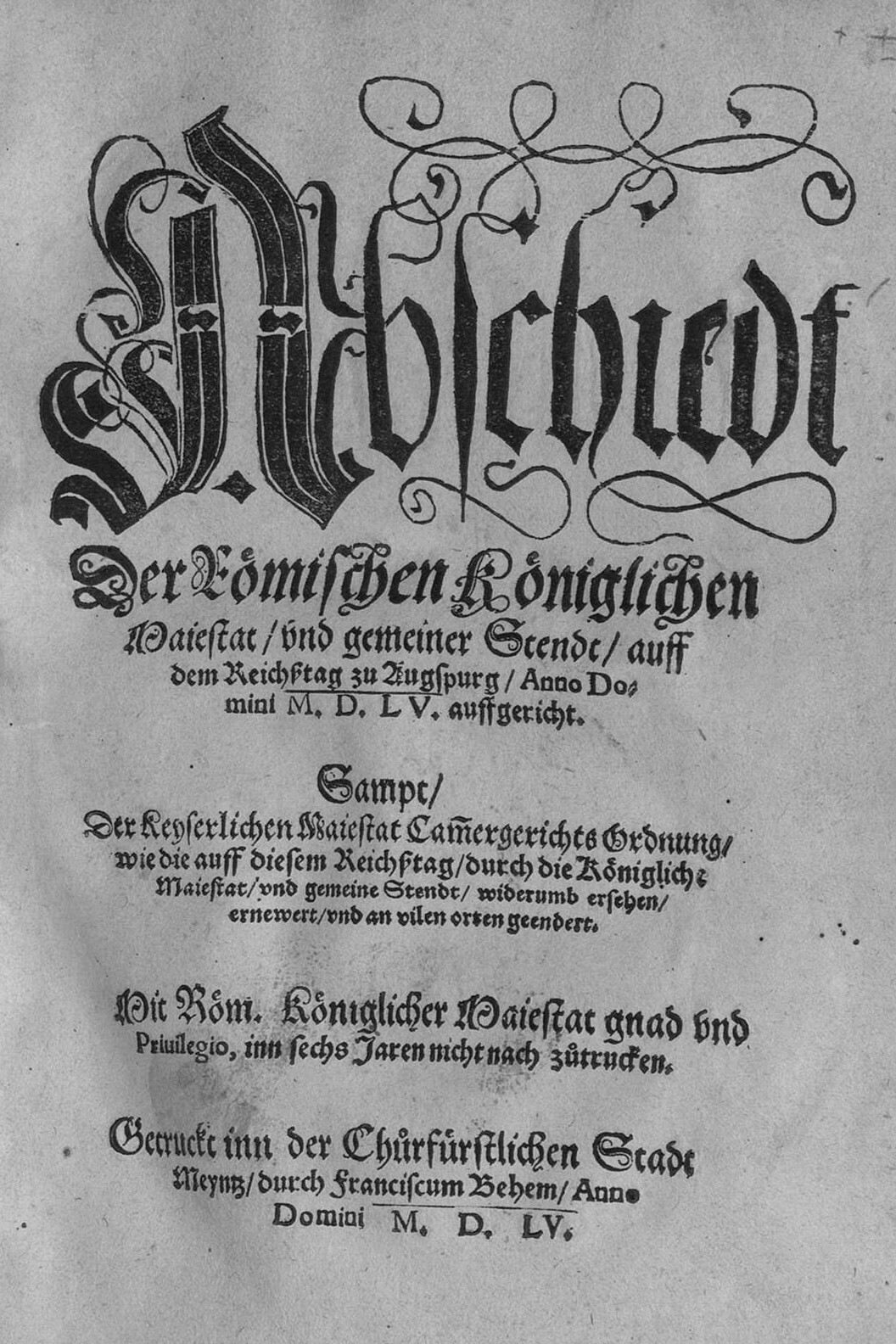
The Peace of Augsburg Lets German Princes Choose Their Faith
After decades of conflict, the Holy Roman Empire allowed each ruler to make his lands Lutheran or Catholic, a settlement summed up later as whose realm, his religion.
On 25 September 1555, the Imperial Diet meeting in the German imperial city of Augsburg adopted a landmark religious settlement between the Catholic and Lutheran estates of the Holy Roman Empire. Ferdinand, the brother of Emperor Charles V, presided over the negotiations, and the agreement formally closed the initial era of armed religious conflict between Catholic and Protestant factions. By granting legal status to Lutheranism alongside Roman Catholicism, the settlement permanently dismantled the institutional religious uniformity of the Holy Roman Empire, creating an unprecedented framework for coexistence among its autonomous territories.
The central principle of the settlement later became known by the Latin phrase cuius regio, eius religio, meaning whose realm, his religion. The phrase does not appear in the treaty itself and is usually credited to the jurist Joachim Stephani, who formulated it decades afterward. Under this rule, each territorial prince held the sovereign right to determine whether Lutheranism or Catholicism would serve as the official faith of his domain. Inhabitants were expected to adopt the confession chosen by their ruler. Subjects unwilling to conform were allowed to sell their property and emigrate to a territory that practiced their preferred faith, after paying certain dues, though serfs were essentially excluded from this right and could leave only if their lords agreed.

Keep reading in Yester
Coming soonKeep following the story
Sources
Image: Michail · Public domain · Wikimedia Commons · cropped
