The Guns Fall Silent on the Western Front
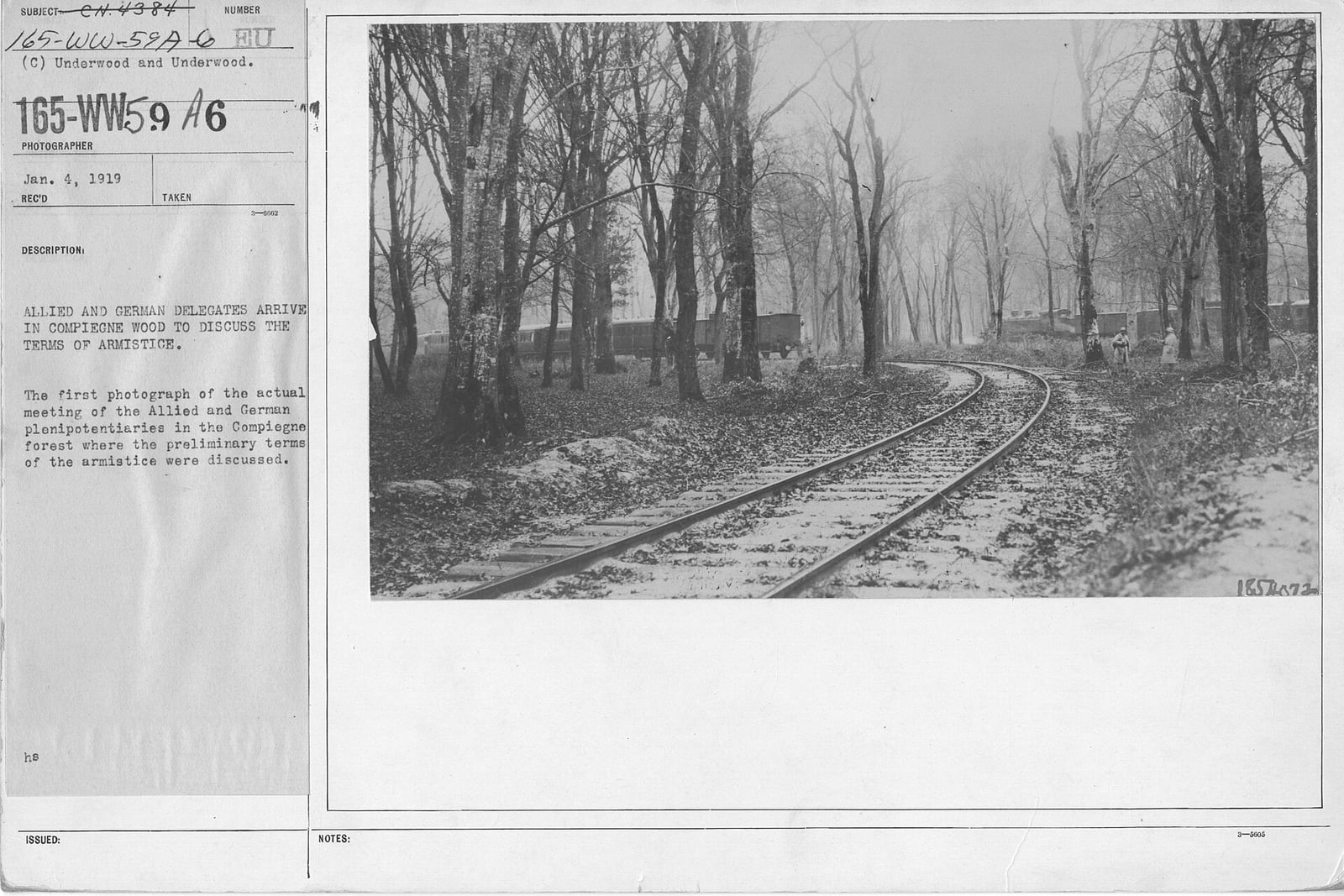
In a railway carriage near Compiègne, Germany signed an armistice that stopped the fighting at 11 a.m.
At about five o'clock on the morning of 11 November 1918, Allied and German representatives gathered in a railway carriage parked in the Forest of Compiègne to sign an armistice. German civilian politician Matthias Erzberger led the delegation from Berlin, while Allied Supreme Commander Ferdinand Foch and British First Sea Lord Admiral Rosslyn Wemyss represented the Entente. The agreement was scheduled to take effect six hours later, at 11:00 a.m. Paris time, formally bringing an end to the fighting across the Western Front after more than four years of conflict.
The path to the railway carriage began with the rapid collapse of Germany's military posture during the late summer and autumn of 1918. Following the Allied breakthrough in the Hundred Days Offensive and the capitulation of Bulgaria, Ottoman, and Austro-Hungarian forces, German Quartermaster General Erich Ludendorff concluded on 29 September that the military situation was hopeless. Berlin appealed to United States President Woodrow Wilson to seek terms based on his Fourteen Points. In late October and early November, naval mutinies at Wilhelmshaven and Kiel helped spark revolution across Germany, and on 9 November a republic was proclaimed and the abdication of Emperor Wilhelm II was announced.

Keep reading in Yester
Coming soonKeep following the story
Sources
- The Armistice (National WWI Museum and Memorial)
- Conditions of the Armistice with Germany, November 11, 1918 (German History in Documents and Images)
- The Armistice and the occupation of the Rhine (The Long, Long Trail)
- In the final hours of World War I, a terrible toll (Associated Press via Military Times)
- The German Revolution and the Kiel mutiny (Alpha History)
- Armistice of 11 November 1918
Image: Unknown author · Public domain · Wikimedia Commons · cropped
