Jayavarman VII Builds Angkor Thom and the Bayon
After driving out the Cham, the Buddhist king raised a new walled capital whose central temple is covered in giant stone faces.
Angkor Thom was founded by King Jayavarman VII, who reigned from about 1181, and was built around the turn of the thirteenth century as the capital of the Khmer Empire. Positioned in present-day Cambodia on the west bank of the Siem Reap River, the site functioned as the political center of an expansive royal construction program. One inscription from the city is read as casting the king as a groom and the city as his bride. While modern observers identify the complex as a distinct foundation, it overlapped parts of Yasodharapura, an earlier capital established roughly three centuries prior, and historical inscriptions as late as the fourteenth century continued applying the older municipal name.
The layout of Angkor Thom covers nine square kilometers, bounded by laterite walls eight meters high and supported by earthen embankments. Each wall extends for three kilometers, framed on the exterior by an encircling moat. Gates positioned at the cardinal points open onto roadways running directly toward the center of the city, while a fifth passage, known as the Victory Gate, provides access to the royal palace area and Victory Square north of the center. Because the central state temple lacks its own surrounding boundary wall or moat, archaeologists interpret the urban fortifications as representing the cosmological mountain ranges and oceans that encompass Mount Meru in Hindu and Buddhist belief.

Keep reading in Yester
Coming soonKeep following the story
Sources
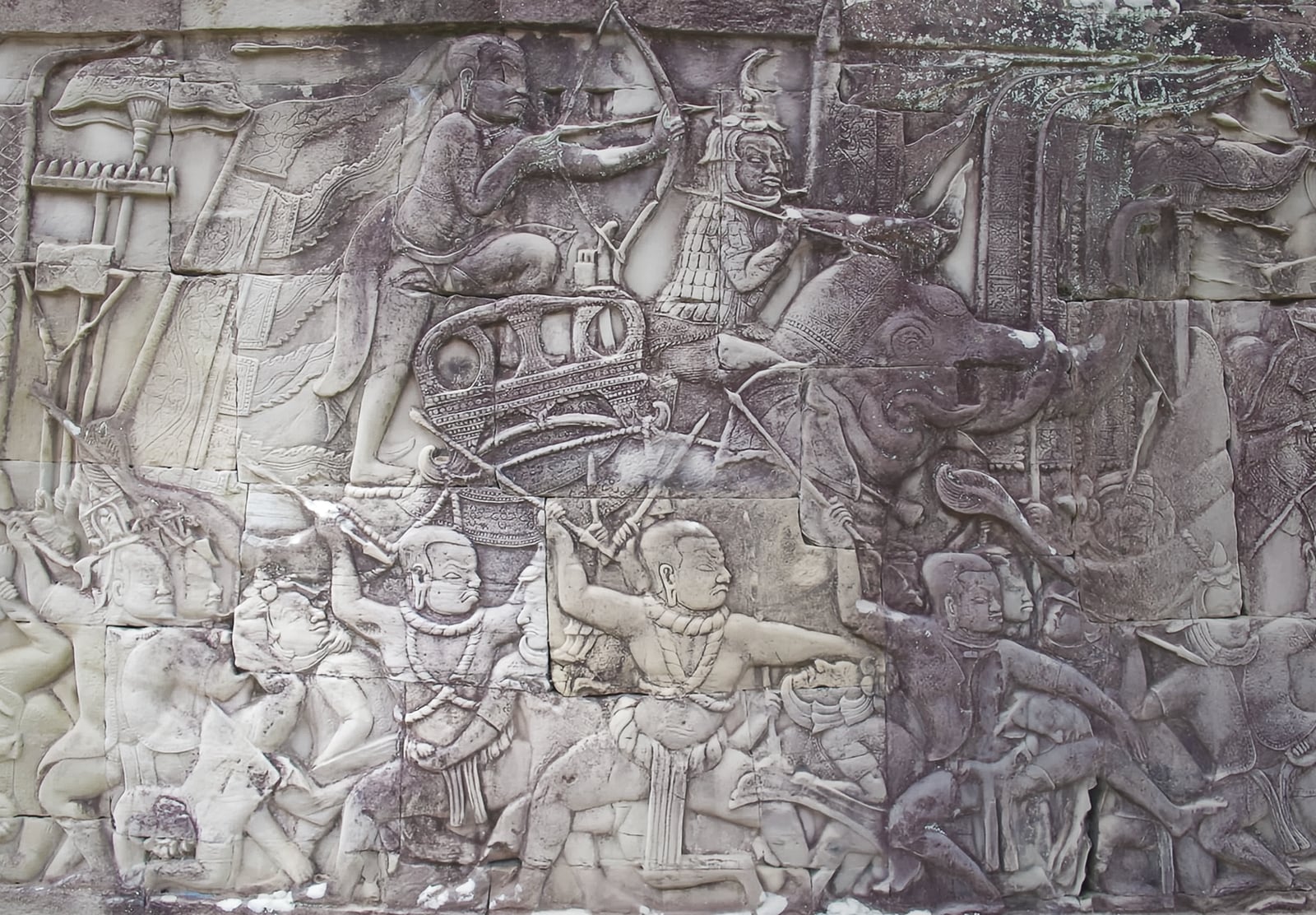
Image: Bas-relief by 12th or century artist. Photo by Artanisen · CC BY 4.0 · Wikimedia Commons · cropped
