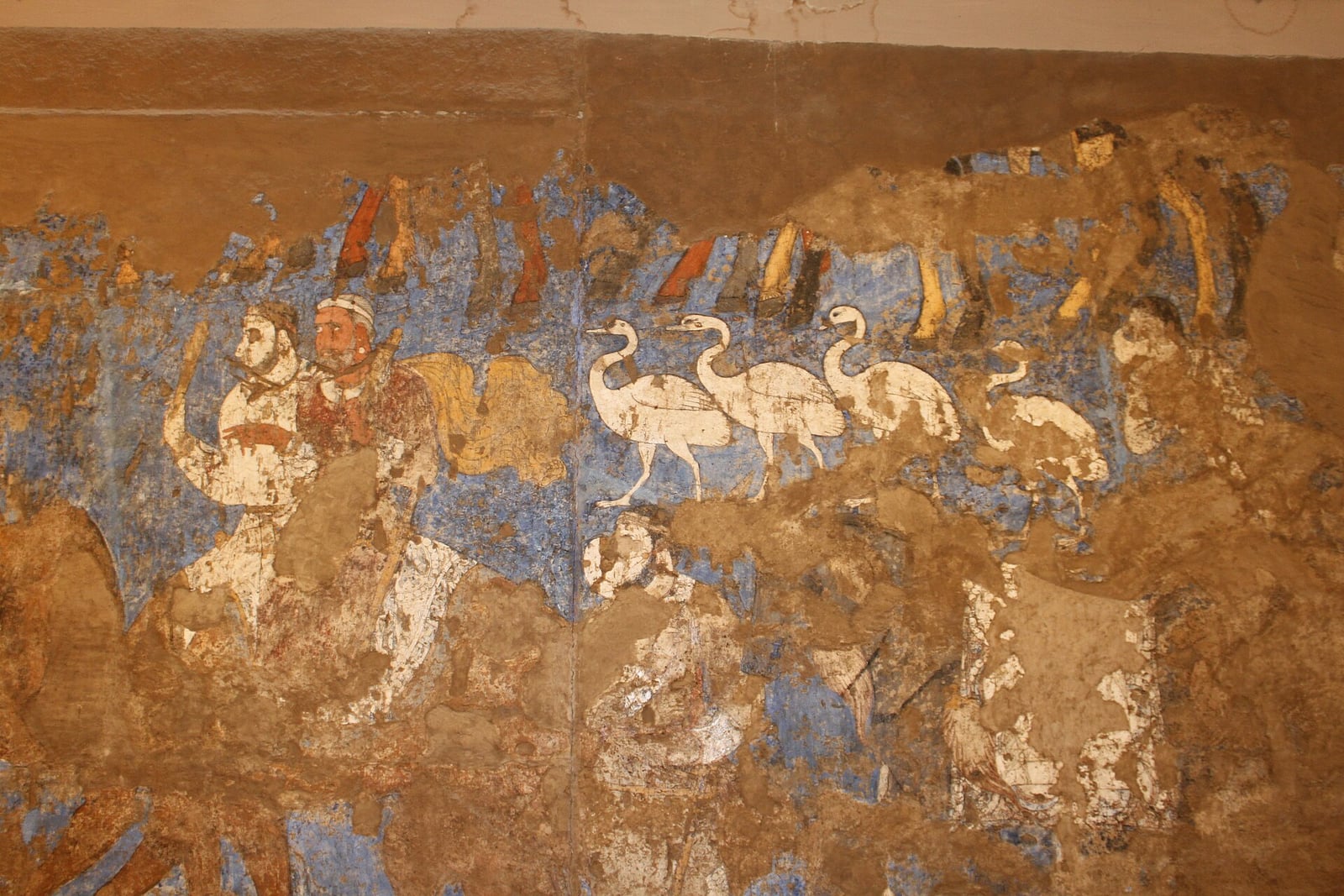
Wall Paintings Show Ambassadors from Across Asia at Samarkand
Seventh-century murals from a Samarkand residence show envoys from China, Korea and Central Asia at the court of King Varkhuman.
In 1965, municipal road construction through the Afrasiab mound, the archaeological site of pre-Mongol Samarkand, cut into the remains of an elite residence. Parts of the wall decorations were damaged or lost before archaeologists intervened. The surviving sections revealed one of the most significant examples of Sogdian art ever recovered: a cycle of seventh-century wall paintings, widely known as the Paintings of the Ambassadors. Today, these works are housed in an on-site museum located on the Afrasiab mound.
Scholars place the creation of the murals in the middle of the seventh century, with proposed dates ranging from about 650 to the 660s, an era defined by geopolitical transition. During this period, the Western Turkic Khaganate was fracturing, while the Tang dynasty expanded its authority into Central Asian territories. According to the Encyclopaedia Iranica, the Chinese emperor Gaozong recognized Varkhuman as governor of Samarkand between 650 and 655. The decorative scheme originally surrounded a square reception room, and many scholars read it as dedicating each wall to a major cultural sphere that influenced the regional politics and commerce of the Silk Road: China, India, Iran, and the steppe world of the Western Turks.

Keep reading in Yester
Coming soonKeep following the story
Sources
Image: Unknown author · Public domain · Wikimedia Commons · cropped
